Category: Market Insights

  • IBR Rates Simplified: A Clear Guide to Interbank Rates

    IBR Rates Simplified: A Clear Guide to Interbank Rates

    IBR Rates Explained: What Is an Interbank Exchange Rate?

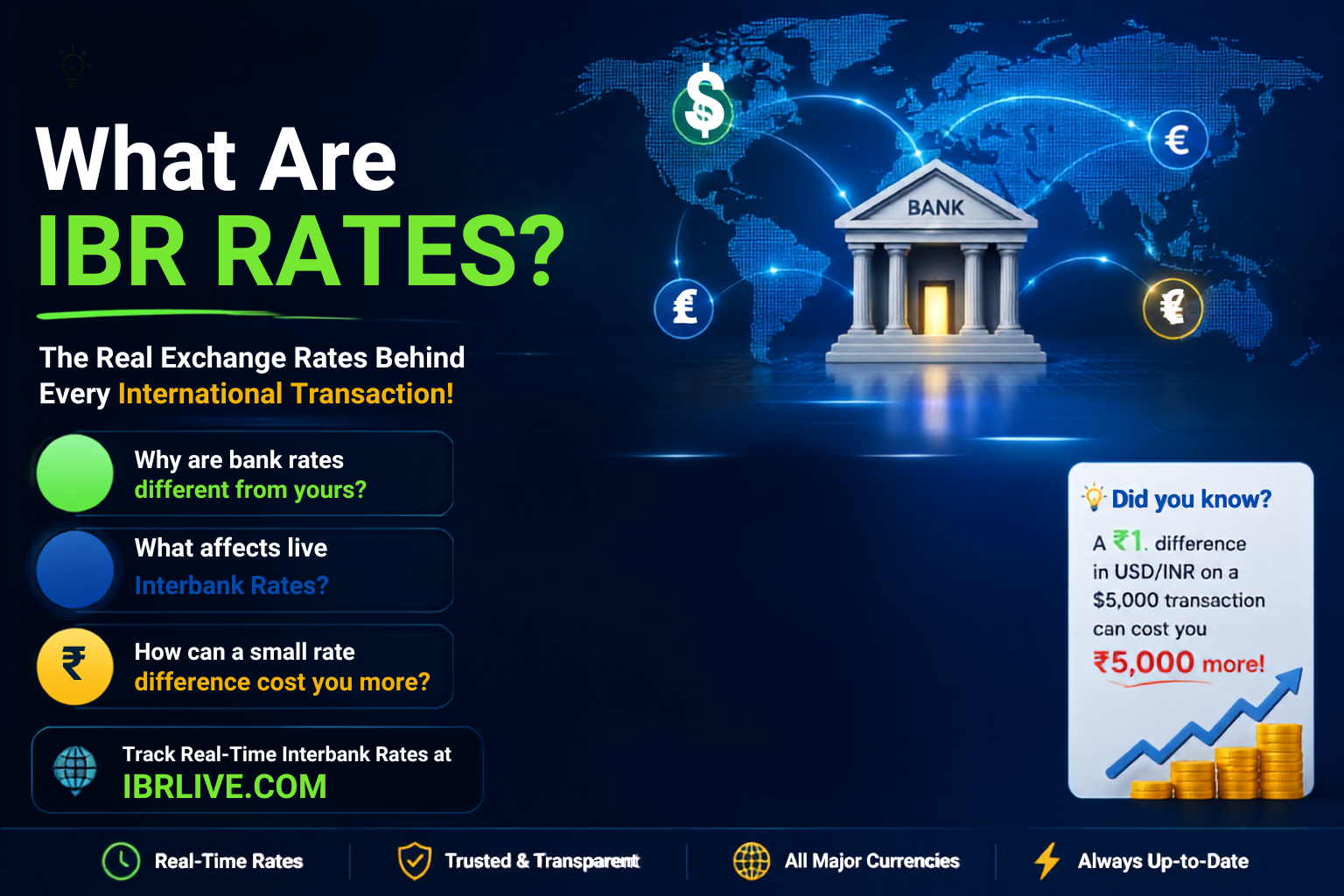
    IBR rates, or interbank exchange rates, are wholesale foreign-exchange market rates that help indicate how currencies are being priced in the market. They are useful for understanding the underlying FX market before comparing a bank, forex provider or payment platform’s customer-facing exchange rate.

    For businesses and individuals dealing with foreign currency, understanding IBR rates can make it easier to compare forex quotes, monitor currency movements and understand the difference between a market reference rate and the rate actually offered for a transaction.

    What Are IBR Rates?

    IBR stands for Interbank Rate or Interbank Exchange Rate.

    An interbank exchange rate refers to the pricing used in the wholesale foreign-exchange market, where banks and other financial institutions trade currencies. These rates can move continuously as market conditions, liquidity, demand, economic data and global events change.

    For example, USD/INR represents the value of one US dollar in Indian rupees. When the market moves, the USD/INR interbank rate can change accordingly.

    IBR rates are particularly useful for:

    • Comparing forex quotes
    • Monitoring currency movements
    • Import and export transactions
    • International payments
    • Treasury and cash-flow planning
    • Currency risk management
    • Understanding forex card and remittance pricing
    • Evaluating foreign-exchange costs

    The important point is that an IBR is a market reference, not necessarily the final rate a retail customer will receive.

    How Do Interbank Exchange Rates Work?

    The foreign-exchange market operates through a network of banks, financial institutions, dealers and other market participants.

    Currency prices are normally quoted using two sides:

    • Bid rate: the price at which a market participant is willing to buy a currency.
    • Ask rate: the price at which a market participant is willing to sell a currency.
    • Bid-ask spread: the difference between the bid and ask prices.
    • Mid-market rate: generally the midpoint between the bid and ask prices.

    For example, if a currency pair is quoted as:

    • Bid: ₹94.70
    • Ask: ₹94.80

    the midpoint would be approximately ₹94.75.

    The exact rates and spreads available in the market can vary depending on liquidity, currency pair, market conditions and data source.

    Are IBR Rates the Same as Spot Rates?

    Not necessarily.

    IBR and spot rate are related concepts, but they should not be treated as interchangeable in every context.

    An interbank rate describes wholesale market pricing between market participants. A spot rate refers to the exchange rate for a spot FX transaction, generally involving settlement on the standard spot timetable applicable to the currencies and market.

    In practice, interbank spot rates are widely used as market references. However, IBR should not simply be defined as another name for every spot rate.

    This distinction becomes particularly important when comparing spot, cash, tom and forward rates.

    What Is the Difference Between IBR, Mid-Market Rate and Retail Forex Rate?

    These terms are often used interchangeably online, but they serve different purposes.

    Rate What it means Typical use
    IBR / Interbank Rate Wholesale FX market pricing Market monitoring and pricing reference
    Mid-market rate Midpoint between bid and ask Currency comparison and reference
    Retail forex rate Rate offered to a customer Actual currency transaction
    RBI/FBIL reference rate Official reference-rate framework for specified currencies Reporting, accounting and other reference purposes

    A customer should therefore not assume that a website’s displayed interbank or mid-market rate will be the exact rate available when purchasing currency or making an international payment.

    Why Is the Retail Forex Rate Different from the IBR?

    A bank or forex provider may add a margin or spread to its customer-facing rate.

    The final rate can be influenced by factors such as:

    • Market liquidity
    • Transaction size
    • Currency pair
    • Operational costs
    • Settlement costs
    • Currency risk
    • Provider margin
    • Payment method
    • Applicable taxes or charges

    For this reason, the rate shown as a market reference and the rate quoted for an actual customer transaction can be different.

    Example

    Suppose the market reference rate for USD/INR is ₹94.75 and a forex provider quotes ₹95.25 for a particular transaction.

    The difference is ₹0.50 per US dollar.

    For a USD 10,000 transaction:

    ₹0.50 × 10,000 = ₹5,000

    Even a relatively small difference in the exchange rate can therefore become significant when the transaction amount is large.

    This is why exporters, importers and businesses often compare the quoted rate with a relevant market reference before finalising an FX transaction.

    What Is the Difference Between IBR and the RBI Reference Rate?

    IBR and the RBI reference rate are not the same thing.

    Interbank rates reflect wholesale FX market pricing and can change continuously.

    The RBI reference-rate framework is a separate official reference mechanism. RBI documentation explains that the USD/INR reference-rate methodology was revised in 2016 to use actual market transactions, and that Financial Benchmarks India Pvt. Ltd. (FBIL) took over computation and dissemination of reference rates from July 2018.

    This distinction matters because an official reference rate should not automatically be treated as the exact rate offered by a bank, forex company or payment provider.

    For regulatory, accounting or reporting requirements, businesses should use the rate specified for the particular purpose rather than assuming that a live IBR is interchangeable with an official reference rate.

    Why Do IBR Rates Change?

    IBR rates are dynamic because the foreign-exchange market responds continuously to new information.

    Some of the major factors include:

    1. Interest Rates

    Changes in interest rates can influence capital flows and demand for currencies.

    For example, changes in monetary policy by the RBI or the US Federal Reserve can influence USD/INR market expectations.

    2. Inflation and Economic Growth

    Inflation, GDP growth, employment data, trade figures and other economic indicators can influence currency demand.

    3. Central Bank Policies

    Statements and policy decisions by central banks can create significant currency movements.

    4. Global Events

    Geopolitical developments, trade restrictions, elections and unexpected economic events can increase volatility.

    5. Market Demand and Liquidity

    Large buying or selling activity can influence currency prices, particularly when market liquidity changes.

    The global FX market is highly active. The BIS reported average OTC FX turnover of around $9.5 trillion per day in April 2025, highlighting the scale and liquidity of the global foreign-exchange market.

    Why Are IBR Rates Important for Businesses?

    IBR rates are particularly useful for companies that regularly deal in foreign currencies.

    Importers

    Importers can monitor market rates when planning payments to overseas suppliers.

    A movement of even a few paise or rupees can have a meaningful impact on the INR cost of a large foreign-currency invoice.

    Exporters

    Exporters receive foreign-currency proceeds and therefore need to monitor exchange-rate movements before converting those proceeds into INR.

    Tracking market rates can help exporters understand the relationship between the market and the rate offered by their bank or forex provider.

    Businesses Making International Payments

    Companies making payments for software, services, equipment, subscriptions or other overseas expenses can use market references to evaluate FX quotes.

    Treasury and Finance Teams

    Treasury teams can use FX market data when monitoring exposures, planning conversions and evaluating hedging decisions.

    How Can Businesses Use IBR Rates to Compare Forex Quotes?

    IBR rates can be used as a reference point, rather than as a guaranteed transaction rate.

    A simple comparison can involve:

    1. Check the relevant market/reference rate.
    2. Obtain the bank or forex provider’s quoted rate.
    3. Calculate the difference between the two.
    4. Multiply the difference by the transaction amount.
    5. Check whether additional fees, taxes or charges apply.
    6. Compare the total effective cost rather than looking only at the headline exchange rate.

    For larger transactions, this approach can help businesses understand how much of the cost comes from the exchange-rate spread versus other transaction charges.

    What Is the IBR Rate for USD/INR?

    There is no single permanent USD/INR IBR.

    USD/INR market rates change throughout the trading day.

    Therefore, an evergreen article should not publish a fixed USD/INR number and present it as the current IBR.

    For a live or transaction-specific rate, users should check a current market data source or the relevant bank/forex provider quote at the time of the transaction.

    IBR Rates vs Forex Card Rates

    IBR rates and forex card rates serve different purposes.

    Feature IBR / Market Reference Forex Card Rate
    Market Wholesale FX market Retail customer market
    Purpose Market reference Card loading/spending
    Pricing Market-based Provider-specific
    Spread Market bid-ask spread May include provider margin
    Customer rate Not necessarily executable for retail Customer-facing rate
    Best use Comparing market conditions Actual travel/card transaction

    A forex card rate can therefore be different from the underlying market reference rate.

    When comparing forex card offers, customers should look at the effective rate and total charges, not only the advertised rate.

    IBR Rates vs Google Exchange Rates

    Search engines and currency-conversion websites often display a mid-market or indicative currency rate.

    That rate can be useful for a quick comparison, but it should not automatically be treated as the exact executable rate for a bank or forex transaction.

    Differences can arise because:

    • Market data may update at different intervals.
    • Different providers may use different data sources.
    • Bid and ask prices may vary.
    • Currency markets continue moving throughout the day.
    • Retail providers apply their own transaction pricing.

    For significant transactions, businesses should compare a current market reference with the actual quote they receive.

    Why Should Exporters and Importers Track IBR Rates?

    For a business dealing with large foreign-currency amounts, even a small exchange-rate movement can affect margins.

    For example, consider an importer with a USD 100,000 payable.

    A movement of ₹0.50 in USD/INR changes the INR value by:

    ₹0.50 × USD 100,000 = ₹50,000

    This is why businesses may track interbank rates while planning currency conversions, negotiating forex quotes or evaluating hedging strategies.

    IBR monitoring can be particularly useful when combined with:

    • Historical rate analysis
    • Forward-rate monitoring
    • Rate alerts
    • Exposure tracking
    • Currency forecasting
    • Hedging strategies

    How IBRLIVE Helps Businesses Monitor IBR Rates

    IBRLIVE provides forex market data and tools designed to help businesses monitor currency movements and compare FX pricing.

    Its FXPRESS platform provides access to live interbank exchange rates, Cash, Tom and Spot rates, historical rates, forward rates and rate alerts.

    For businesses and technology platforms that need programmatic access to FX data, IBRLIVE also provides an Exchange Rate API with bid, ask, last-trade and other forex data through API endpoints.

    These tools can help businesses use market data as a reference when planning foreign-currency transactions.

    Important: Market/reference rates should not automatically be treated as the final customer transaction rate. Actual rates can vary depending on the transaction, currency, amount, provider, spread, fees, taxes and settlement requirements.

    Where Can You Check IBR and Reference Rates?

    When checking an exchange rate, consider the purpose for which you need it.

    For live market monitoring, use a reliable real-time FX data source.

    For regulatory, accounting or reporting requirements, check whether a specific official reference rate is required.

    RBI’s published information explains the development and methodology of India’s USD/INR reference-rate framework, while FBIL has handled computation and dissemination of the relevant reference rates since July 2018.

    You can also use IBRLIVE’s FX tools for live interbank market monitoring and related FX analysis.

    Common Uses of IBR Rates

    IBR rates can be useful for:

    • International payments
    • Import payments
    • Export proceeds
    • Foreign-currency invoicing
    • Overseas education payments
    • Travel forex planning
    • Forex card comparisons
    • Treasury management
    • Currency risk management
    • Forward-rate analysis
    • Comparing bank and forex-provider quotes
    • FX technology and API integrations

    Frequently Asked Questions About IBR Rates

    What does IBR stand for in forex?

    IBR stands for Interbank Rate or Interbank Exchange Rate. It refers to wholesale foreign-exchange market pricing between financial institutions and is commonly used as a market reference.

    Is IBR the same as the mid-market rate?

    Not necessarily. The mid-market rate is generally the midpoint between a currency pair’s bid and ask prices. IBR is a broader term for interbank/wholesale FX pricing.

    Is IBR the same as the RBI reference rate?

    No. The interbank market rate and the official RBI/FBIL reference-rate framework serve different purposes. The RBI reference-rate methodology is a separate official reference mechanism.

    Why is my bank’s exchange rate different from the IBR?

    Banks and forex providers may add spreads, margins, operational costs and other transaction-specific components to their customer-facing rates.

    Does IBR change throughout the day?

    Yes. Wholesale FX market prices can change continuously in response to market demand, liquidity, economic information, central-bank decisions and global events.

    Can individuals get the exact interbank rate?

    Individuals can view market-reference rates, but the rate displayed as an IBR or mid-market rate is not necessarily the exact executable rate a retail customer will receive from a bank or forex provider.

    Why is the USD/INR IBR different from the rate I receive?

    The quoted customer rate may include a spread or margin over the relevant market reference, along with applicable charges or taxes.

    Why should exporters track IBR rates?

    Exporters can use IBR rates to monitor currency movements, compare conversion quotes and understand how changes in USD/INR or another currency pair may affect their INR realisation.

    Why should importers track IBR rates?

    Importers can use market-reference rates to monitor the INR cost of foreign-currency payables and evaluate forex quotes before making payments.

    Can IBR rates help with currency hedging?

    Yes. Market-rate monitoring can be one input into FX risk-management decisions. However, businesses should evaluate their exposure, cash-flow timing and hedging requirements before choosing a hedging strategy.

    Final Takeaway

    IBR rates provide an important reference for understanding wholesale foreign-exchange pricing, but they are not automatically the same as the rate a customer receives for a forex transaction.

    The most useful way to evaluate an FX quote is to compare it with an appropriate market reference and then consider the spread, transaction charges, taxes, settlement terms and other applicable costs.

    For businesses, exporters and importers, regularly monitoring IBR rates can provide better visibility into currency movements and help support more informed FX decisions.
  • Forex Card Rate Exposed: The Hidden Difference Banks Don’t Explain

    Forex Card Rate Exposed: The Hidden Difference Banks Don’t Explain

    Forex Card Rate vs Interbank Exchange Rate: What’s the Difference?

    When you check an exchange rate online, you may see a USD/INR rate such as ₹95.59 per US dollar. However, this does not necessarily mean you will get USD at ₹95.59 when you load a forex card, buy foreign currency from a bank, or make an international card transaction.

    The reason is simple: the interbank or market rate is a benchmark for the currency market, while the rate offered to a retail customer may include a spread, markup, fees or other pricing adjustments.

    For example, if the USD/INR reference or market rate is ₹95.59, a bank may quote different buying and selling rates depending on whether you are buying or selling USD and which transaction channel you use.

    This difference becomes particularly important when comparing forex cards, bank exchange rates, cash currency rates and international card transactions.


    What Is a Forex Card Rate?

    A forex card rate is the exchange rate used when foreign currency is loaded onto or converted through a prepaid forex card, or when a card issuer applies a currency conversion rate to an international transaction.

    The exact rate depends on the card issuer, card network, currency, transaction type and applicable fees.

    A forex card rate may therefore be different from the interbank or mid-market exchange rate you see online.

    It is important to check both:

    • The exchange rate being applied
    • Any currency conversion or foreign transaction fee
    • Card issuer markup, if applicable
    • ATM withdrawal charges
    • Other applicable card fees

    Visa’s current rules require issuers to disclose applicable international transaction or currency-conversion fees and the exchange rate used. Visa also allows the applicable conversion rate to be adjusted through an issuer fee or issuer-determined markup in certain circumstances.


    What Is an Interbank Exchange Rate?

    The interbank exchange rate refers to the rate at which currencies are traded in the wholesale foreign exchange market between financial institutions.

    It is commonly used as a benchmark when assessing whether a retail forex quote is competitive.

    However, the interbank rate is not automatically the rate available to an individual customer.

    For example:

    USD/INR market reference rate = ₹95.59

    A customer buying USD may receive a higher rate, while someone selling USD may receive a lower rate.

    The difference reflects the pricing spread and other costs involved in providing the retail forex service.


    Forex Card Rate vs Interbank Exchange Rate: Quick Comparison

    Rate / Pricing Type What It Means Illustrative USD/INR Rate
    Interbank / Market Rate Approximate wholesale/reference market rate used for comparison ₹95.59
    TT Buying Rate Rate at which a bank buys USD through a telegraphic transfer ₹95.10
    TT Selling Rate Rate at which a bank sells USD through a telegraphic transfer ₹96.10
    Bank Buying Rate Rate at which the bank buys foreign currency from the customer ₹95.00
    Bank Selling Rate Rate at which the bank sells foreign currency to the customer ₹96.20
    Forex Card Rate Rate applicable when loading/using a forex card, depending on issuer/network and applicable charges ₹96.00*
    Cash Buying Rate Rate at which a bank/forex provider buys foreign currency cash ₹94.20
    Cash Selling Rate Rate at which a bank/forex provider sells foreign currency cash ₹97.00

    Note: The rates above are illustrative examples only, designed to explain how different forex rates can relate to a market reference rate of ₹95.59. They are not live quotations from a particular bank or forex provider. Actual rates can vary based on the bank, transaction type, currency, amount, market conditions, fees and applicable markup.


    Why Is the Forex Card Rate Different From the Interbank Rate?

    There are several reasons why your forex card rate may differ from the interbank exchange rate.

    1. Retail pricing

    Financial institutions generally do not provide wholesale market pricing to every retail customer.

    The customer-facing rate can include a spread over the underlying market rate.

    2. Card network conversion

    For international card transactions, the card network may determine or provide a conversion rate depending on the transaction and network rules.

    Visa, for example, states that its currency conversion rate can be adjusted through an issuer fee or issuer-determined markup.

    3. Issuer markup

    The card issuer may apply its own markup or foreign currency conversion fee.

    Therefore, two cards using the same card network can still have different effective costs.

    4. Transaction-specific charges

    The exchange rate is only one part of the total cost.

    You should also consider:

    • Foreign transaction fees
    • Currency conversion fees
    • Forex card loading fees
    • Reload fees
    • ATM withdrawal charges
    • Cross-currency conversion charges
    • Other card-specific fees

    Is the Interbank Rate the Same as the Mid-Market Rate?

    Not necessarily.

    The terms interbank rate, mid-market rate and reference rate are often used loosely in consumer-facing content, but they can refer to different concepts.

    A market quote normally has a bid price and an ask price.

    The midpoint between the two is often called the mid-market rate.

    For example:

    • Bank/market buys USD at ₹95.50
    • Bank/market sells USD at ₹95.68
    • Midpoint = approximately ₹95.59

    This is a simplified illustration. Actual market quotes move continuously.

    Therefore, when comparing a retail forex quote with an online rate, first check what rate the website is actually displaying.


    What Is the Difference Between Buying and Selling Rates?

    The difference becomes clearer when you look at the four commonly used bank rates.

    TT Buying Rate

    The TT Buying Rate is generally the rate at which the bank buys foreign currency through a telegraphic transfer transaction.

    For example, if you receive USD through a transfer and want to convert it into INR, the applicable buying rate may be relevant.

    TT Selling Rate

    The TT Selling Rate is generally the rate at which the bank sells foreign currency through a telegraphic transfer.

    If you are sending USD abroad through a bank transfer, the selling rate may be relevant.

    Bank Buying Rate

    The Bank Buying Rate is the rate at which the bank purchases foreign currency from the customer.

    Bank Selling Rate

    The Bank Selling Rate is the rate at which the bank sells foreign currency to the customer.

    The buying and selling rates are normally different because the provider needs to account for the spread and costs associated with providing the currency service.


    Why Don’t Banks Offer USD at ₹95.59 If That Is the Market Rate?

    This is one of the most common questions about forex pricing.

    Suppose the current USD/INR market reference rate is ₹95.59.

    If you want to buy USD, the bank may quote a selling rate above ₹95.59.

    If you want to sell USD, the bank may quote a buying rate below ₹95.59.

    For example:

    Transaction Illustrative Rate
    Market/reference rate ₹95.59
    Bank buys USD ₹95.10
    Bank sells USD ₹96.10

    The difference between the reference level and the customer-facing rate is not necessarily a hidden charge. It can reflect the provider’s spread, operating costs, market conditions and transaction-specific pricing.

    That is why comparing only one number can give you an incomplete picture.


    Does Every Bank Offer the Same Forex Card Rate?

    No.

    Different banks and card issuers can have different pricing structures.

    The effective cost can depend on:

    • Currency
    • Card type
    • Issuer
    • Loading method
    • Transaction location
    • International transaction fee
    • Currency conversion fee
    • ATM withdrawal
    • Cross-currency conversion
    • Applicable taxes and other charges

    So, instead of asking only “What is the forex card rate?”, compare the total effective cost.


    Is a Lower Forex Card Rate Always Better?

    Not necessarily.

    Suppose:

    Card A: ₹95.90 exchange rate + additional foreign transaction fee

    Card B: ₹96.00 exchange rate + no additional foreign transaction fee

    Card B may potentially be cheaper overall depending on the transaction amount and fee structure.

    This is why the exchange rate alone should not be used to compare forex cards.

    A better comparison is:

    Total INR cost = currency conversion amount + applicable fees and charges


    How Does a Forex Card Work?

    A forex card is a prepaid card that can hold foreign currency or facilitate international currency transactions, depending on the product.

    A typical process is:

    1. You purchase/load foreign currency.
    2. The issuer converts your INR into the selected currency.
    3. The applicable rate and charges are applied.
    4. You use the card overseas for eligible purchases or withdrawals.
    5. The transaction is settled through the relevant payment network.

    The exact mechanics vary between forex-card products.

    Before travelling, check the issuer’s current terms for supported currencies, fees, ATM withdrawals, reloads and cross-currency transactions.


    Visa or Mastercard: Does the Card Network Matter?

    Yes.

    The card network can play a role in determining the currency conversion process for international card transactions.

    For example, Visa publishes rules explaining how international transaction and currency-conversion fees and exchange rates must be disclosed. Its rules also allow certain issuer-level fees or markups to affect the final conversion.

    Therefore, when comparing two forex cards, don’t look only at whether they are Visa or Mastercard.

    Check the issuer’s complete pricing and fee structure.


    What Is Dynamic Currency Conversion (DCC)?

    Dynamic Currency Conversion (DCC) occurs when a merchant or ATM abroad offers to convert your transaction into your home currency instead of charging you in the local currency.

    For example, an ATM in the USA may ask whether you want the transaction displayed in:

    • USD, or
    • INR

    If you choose INR, the ATM/operator may apply its own conversion rate and markup.

    Visa’s rules require DCC transactions to disclose the conversion rate and applicable commission, fee, markup or margin.

    Should you choose DCC?

    Not automatically.

    Compare the offered conversion rate and charges before accepting it.

    In many cases, paying in the local currency allows your card issuer/network to handle the conversion instead, but you should still check your card’s own fees.


    Example: USD/INR at ₹95.59

    Let’s understand the difference with a simple example.

    Assume:

    Market/reference USD/INR rate = ₹95.59

    You want to purchase USD 1,000.

    At the reference rate:

    USD 1,000 × ₹95.59 = ₹95,590

    But if the bank’s selling rate is ₹96.10:

    USD 1,000 × ₹96.10 = ₹96,100

    The difference is:

    ₹96,100 − ₹95,590 = ₹510

    This is before considering any additional fees or taxes that may apply.

    The example shows why the market/reference rate and the customer-facing rate can be different.

    It does not mean that every bank will have a ₹96.10 selling rate. Actual rates vary.


    What Is the RBI Reference Rate?

    The RBI’s USD/INR reference-rate framework is different from a bank’s retail customer rate.

    The Reserve Bank of India revised the methodology for the USD/INR reference rate in 2016 so that it is based on a volume-weighted average of actual market transactions during a selected window. Since July 2018, FBIL has taken over computation and dissemination of the reference rates.

    Therefore:

    RBI/FBIL reference rate ≠ guaranteed retail customer rate

    Similarly:

    Interbank/market rate ≠ guaranteed forex card rate

    These distinctions are important when comparing forex pricing.


    Interbank Rate vs RBI Reference Rate vs Forex Card Rate

    Rate Primary Purpose Customer Gets It Directly?
    Interbank/Market Rate Wholesale market benchmark/market pricing reference Usually no
    Mid-Market Rate Midpoint between market bid and ask Usually no
    RBI/FBIL Reference Rate Official reference/benchmark rate No
    Bank TT Rate Customer-facing bank transfer pricing Yes, where applicable
    Bank Cash Rate Customer-facing physical currency pricing Yes
    Forex Card Rate Card loading/conversion pricing Yes, depending on card/product
    Card Network Rate Currency conversion used within the card network framework May form part of the final card rate

    How Can You Compare a Forex Card Rate With the Interbank Rate?

    Use this simple process.

    Step 1: Check the benchmark

    Start with the current market or reference rate.

    For this example:

    USD/INR = ₹95.59

    Step 2: Check the card’s actual rate

    Find out how much INR is required to load or transact for the same USD amount.

    Step 3: Check the fees

    Look for:

    • Foreign transaction fee
    • Currency conversion fee
    • Loading fee
    • Reload fee
    • ATM fee
    • Cross-currency fee
    • Other applicable charges

    Step 4: Calculate the effective rate

    Don’t compare the headline exchange rate alone.

    Calculate the total INR cost for the actual amount you plan to spend.

    Step 5: Compare like-for-like

    Compare the same:

    • Currency
    • Amount
    • Transaction type
    • Date/time
    • Card/provider
    • Fees

    This gives you a much more meaningful comparison.


    How Can You Reduce Your Forex Cost?

    You can potentially reduce your overall forex cost by:

    1. Comparing the effective rate

    Don’t choose a provider solely because its advertised exchange rate looks attractive.

    2. Checking the spread

    Compare the provider’s buying/selling rate against a reliable market benchmark.

    3. Understanding card fees

    A slightly better exchange rate may not compensate for high transaction or withdrawal fees.

    4. Avoiding unnecessary DCC

    When offered a choice between local currency and INR abroad, understand the conversion rate and charges before accepting the conversion.

    5. Planning larger transactions

    For significant transactions such as overseas education payments, travel expenses or business payments, even a small difference in the effective exchange rate can affect the final INR cost.

    6. Monitoring rates

    Exchange rates change continuously. Monitoring the market can help you understand whether a quoted retail rate is broadly competitive.


    Why Is Monitoring the Interbank Rate Useful?

    For businesses, students, travellers and individuals dealing with foreign currency, an interbank or market benchmark provides a useful reference point.

    For example, if the market reference rate is ₹95.59 and a provider quotes USD at ₹97.00, you can immediately see that the customer-facing quote is significantly above the reference level.

    That does not automatically mean the provider is expensive because fees, transaction type and other factors also matter.

    But the benchmark gives you a starting point for comparison.


    How IBRLIVE Helps You Compare Forex Rates

    IBRLIVE provides access to live interbank/reference-rate information and forex intelligence tools that can help businesses and users benchmark currency rates.

    Through its FXPRESS platform, users can monitor market/reference rates and related forex information instead of relying on a single retail quote.

    For businesses, this can be useful when:

    • Comparing bank forex quotations
    • Monitoring USD/INR movements
    • Evaluating currency conversion costs
    • Tracking forward-rate information
    • Reviewing historical forex data
    • Monitoring rates for business decisions

    Important: IBRLIVE’s reference-rate tools are intended for benchmarking and forex intelligence. They should not be interpreted as a guarantee that a bank or other provider will offer the same retail transaction rate.


    Forex Card Rate vs Interbank Rate for Students

    Students travelling abroad or paying overseas education expenses should look beyond the advertised forex card rate.

    Consider:

    • Currency conversion rate
    • Forex card loading charges
    • ATM withdrawal charges
    • International transaction fees
    • Cross-currency conversion
    • University payment requirements
    • Tuition-payment platform charges
    • Applicable taxes

    For large education payments, the difference between the benchmark rate and the actual transaction rate can become significant.


    Forex Card Rate vs Interbank Rate for Travellers

    For travellers, the most important number is usually the effective cost of spending abroad.

    Before choosing a forex card, compare:

    1. Loading rate
    2. Reload charges
    3. ATM withdrawal fee
    4. Cross-currency charges
    5. International transaction fee
    6. Supported currencies
    7. Card replacement charges
    8. Refund/cash-out terms

    A card with a competitive headline rate may not necessarily have the lowest total cost.


    Forex Card Rate vs Bank Rate: Which One Should You Compare?

    There is no single rate that is always the “best.”

    The right comparison depends on what you are doing.

    Your Requirement Rate/Cost to Check
    Buying foreign currency cash Cash selling rate + fees
    Selling foreign currency cash Cash buying rate
    Sending money through bank transfer TT selling rate + applicable charges
    Receiving foreign currency TT buying rate
    Loading a forex card Forex card loading rate + fees
    Paying by international card Card network/issuer conversion rate + fees
    Comparing market pricing Interbank/mid-market/reference rate

    Common Mistakes When Comparing Forex Rates

    Mistake 1: Assuming the Google rate is your final rate

    Search engines and financial websites may show a market/reference rate that isn’t the rate available to retail customers.

    Mistake 2: Comparing buying and selling rates incorrectly

    A buying rate and selling rate represent different sides of a transaction.

    Mistake 3: Ignoring fees

    A seemingly attractive exchange rate can be offset by transaction or card charges.

    Mistake 4: Assuming every bank has the same rate

    Banks and forex providers can use different pricing structures.

    Mistake 5: Comparing different transaction types

    Cash, TT transfers, forex cards and international card payments can have different rates.

    Mistake 6: Treating the reference rate as a guaranteed customer quote

    A reference rate is useful for benchmarking, but it does not guarantee the rate you will receive.


    FAQs About Forex Card Rate vs Interbank Exchange Rate

    Is the forex card rate the same as the interbank rate?

    No. The forex card rate may be based on a market or card-network rate but can include issuer-level markup, fees or other pricing adjustments.

    What is the USD/INR rate today?

    For the example used in this article, the USD/INR reference/market rate is ₹95.59 per USD. Currency markets move continuously, so the actual rate can change during the day.

    Recent market reporting has placed the rupee around the ₹95.55–₹95.71 range, highlighting how quickly USD/INR can move.

    Is ₹95.59 the rate I will get when buying USD?

    Not necessarily. ₹95.59 is being used here as a market/reference benchmark. A bank or forex provider may quote a different buying or selling rate.

    What is the difference between TT buying and TT selling rate?

    The TT buying rate generally applies when the bank buys foreign currency through a transfer, while the TT selling rate generally applies when the bank sells foreign currency through a transfer.

    Why is the bank selling rate higher than the buying rate?

    The difference generally reflects the spread and costs associated with providing the foreign exchange service.

    Is the RBI reference rate the same as the interbank rate?

    No. They are related benchmarks but should not be treated as identical. The RBI/FBIL reference rate is calculated under a defined methodology, while interbank market rates reflect actual market trading conditions.

    Does a forex card always offer a better rate than cash currency?

    Not necessarily. Compare the total cost, including the exchange rate and applicable fees, before deciding.

    What should I check before choosing a forex card?

    Check the exchange rate, loading fee, reload fee, ATM withdrawal charges, foreign transaction fees, cross-currency charges and other card-specific costs.

    How can I compare a bank’s forex rate?

    Compare the bank’s customer-facing buying or selling rate with a reliable market/reference benchmark and then check all applicable charges.


    Key Takeaway

    The forex card rate and interbank exchange rate are not the same thing.

    If the current USD/INR market/reference rate is ₹95.59, you should not automatically expect to buy USD at ₹95.59. A bank, forex provider or card issuer may apply a different customer-facing rate based on its spread, pricing structure, transaction type and applicable fees.

    The best way to evaluate a forex quote is to compare the actual effective cost against a reliable market benchmark rather than looking at the exchange rate alone.

    For businesses and individuals dealing with foreign currency, monitoring interbank/reference rates can provide a useful benchmark for understanding retail forex pricing.