by sohamkumar245 | Feb 7, 2026 | Exchange Rate API
Introduction: What India’s Forex Companies Should Do Next
If you’ve ever gone to a money exchange counter to get dollars before a vacation, you know how out of date it feels. For FFMCs (Full-Fledged Money Changers), the problem is clear: they have obsolete technology, have to change rates by hand, and don’t have enough customers.
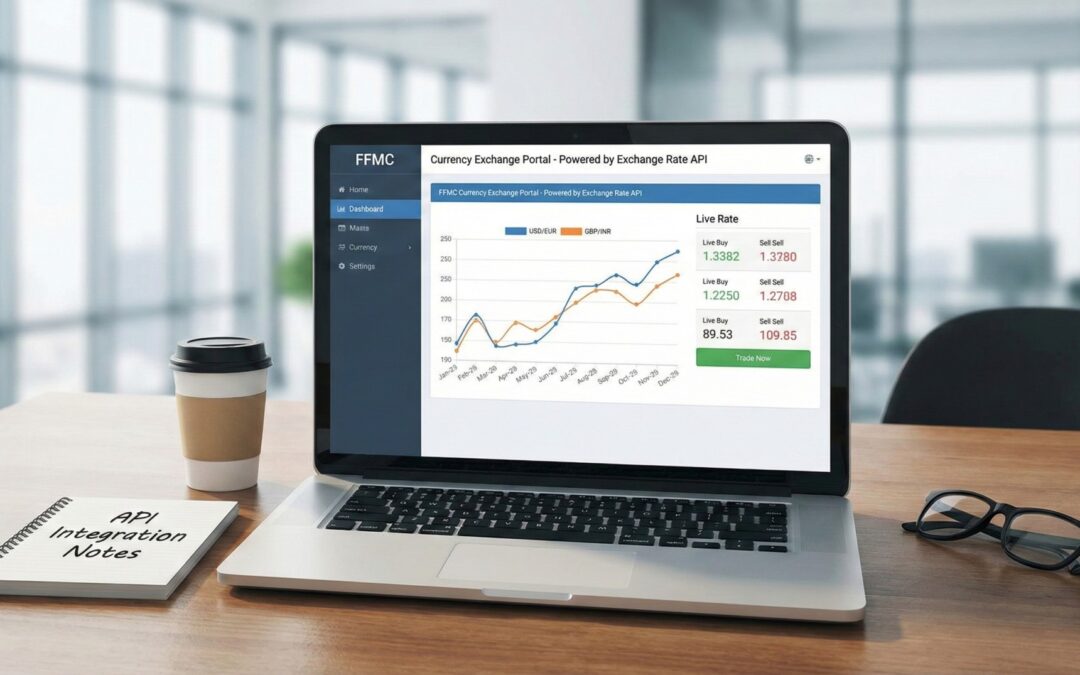
But Currency Rate API like IBRLIVE are altering things quickly. FFMCs can now set up online currency exchange platforms that automatically reflect actual currency rates, handle digital orders, and follow RBI laws. This makes things more open and helps them make more money.
In a world following COVID where convenience is important, digitizing foreign exchange is no longer a nice thing to have; it’s a must.
Why FFMCs Should Be on the Internet
The Indian currency market is very big, with a daily transaction of almost $40 billion (RBI statistics, 2024). Still, over 70% of FFMCs still transact business over the phone or at the counter.
But they want it to be as easy as “ordering food with book currency.” Websites like BookMyForex and ExTravelMoney have proved that internet platforms may make it easy to follow the rules while also giving you live forex trading charts and speedy money exchange online.
FFMCs can do these things with APIs like IBRLIVE:
- Get live foreign currency rates from reliable interbank sources.
- Change the rates of different currencies on their website or app in real time.
- Take orders to buy and sell every day of the week, 24 hours a day.
- Publishing clear pricing is a good way to make sure you obey the rules.
How FFMC Portals Make Use Currency Rate API
Let’s divide it down into smaller parts that make sense.
The Currency Rate API is what lets you receive currency data in real time.
For instance, the IBRLIVE API connects to live market feeds so you may see real-time chart data for USD/INR, EUR/USD, or even XAUUSD in a matter of milliseconds.
Here’s what happens behind the scenes:
- Every few seconds, the API gets real-time currency rates.
- Your website offers prices for buying and selling with a markup already added.
- Customers can look at live charts of forex trading that are always up to date.
- Transactions that are done are transmitted to compliance dashboards for auditing and reporting to the RBI.
This solves one of the biggest concerns for FFMCs: inaccuracies in manual rates that can cost lakhs every day in lost margins or compliance violations.
Key Features of a Good Online Currency Exchange Platform
A great FFMC gateway should have the following:
- Current Rates of Currency: Use an Exchange Rate API to show the current rates for buying and selling.
- Tool for converting currencies: Give users instant access to conversions, like the live EUR/USD chart.
- Instant Booking: Customers can lock in prices before they get to the desk.
- Gateway for Safe Payments: You can use UPI, credit and debit cards, and online banking with it.
- Compliance Dashboard: Pairs transactions with RBI reporting forms.
- Mobile-Responsive UI: User Interface That Works on Phones Let consumers make reservations on their phones while they are out and about.
FFMCs get correct INR pairings for their location, data with low latency, and a format that works well for active financial websites when they add IBRLIVE’s API.
A Step-by-Step Guide to Using IBRLIVE’s API
- Sign up and get your API keys – Visit IBRLIVE’s website to get to the developer console and make your own API key.
- Choose Your Money- Many people utilize USD, EUR, GBP, JPY, CAD, SGD, and so on. There are live charts for the GBP/USD and the currency market, among other pairs, in the API.
- Embed the Endpoint- Developers can receive real-time rates by putting the Endpoint in REST or JSON format.
- Put on a Rate Markup- If IBRLIVE’s USD/INR is 83.11, for example, FFMCs can add ₹0.25 to the price to cover costs and make money.
- Make Tools to See- Add live charts and trend graphs to forex trading to make it easier for users.
- Watch how well it works- The API keeps track of uptime and latency, which is particularly critical for risk teams and decisions made in the boardroom.
The Regulatory Edge: Following the Rules of RBI FFMC
The Reserve Bank of India’s (RBI) Master Circular for FFMCs (updated in 2024) stipulates that dealers must be honest about their pricing and maintain track of all changes online.
To simply show live exchange rates, you can use a reliable Currency Rate API like IBRLIVE. Also, FFMCs minimize the danger of not following the rules and retain a record of rates that can be traced, which is a huge bonus during audits.
What Sets IBRLIVE Apart from Global APIs?
| Feature |
IBRLIVE |
OANDA/Currencylayer |
| Market Focus |
Indian + Asian forex markets |
Primarily US and Europe |
| Data Latency |
Low Latency |
1-2 seconds |
| Regulatory Alignment |
Designed for RBI-compliant FFMCs |
General global compliance |
| Pricing Flexibility |
INR-based billing for Indian clients |
USD based billing |
| Customer Support |
Dedicated Indian desk |
Time-zone delayed |
When it comes to FFMC-specific solutions, IBRLIVE is better than generic APIs that don’t take into account local market realities or RBI compliance standards.
Case Study: How to grow from a physical store to using APIs
XYZ Forex Services is a medium-sized FFMC in Pune, for example.
Every morning, they had to phone banks by hand to find out the latest rates, which took more than an hour.
After implementing IBRLIVE’s Currency Rate API, they accomplished the following:
- It now takes less than 5 seconds to change the rates instead of 60 minutes.
- Every day, orders climbed by 32%.
- Got logs that were ready to be checked for every rate change.
Their boss said: “IBRLIVE didn’t just tell us things; it gave us power.”
Conclusion: API-First FFMCs will rule the future.
India’s foreign exchange market is now catching up with the surge in digital payments. FFMCs don’t just establish online money exchange sites with live forex rates because it’s trendy; they also do it to secure their license for the future.
A modern FFMC powered by IBRLIVE’s Currency Rate API enables tech-savvy travelers and exporters who expect quick conversions real-time information and builds trust.
It’s not a matter of whether you should go digital; it’s a matter of how rapidly you can.
FAQs
Q1: Is it against the law for FFMCs to offer forex online in India?
Yes. RBI lets FFMCs show live rates and take orders online as long as KYC and in-person verification stay the same.
Q2: Why is IBRLIVE better than open APIs?
IBRLIVE makes sure that the rates are correct according to the RBI and that adjustments to the INR are faster than those from global APIs like Fixer or Currencylayer.
Q3: Can IBRLIVE give me live charts for gold and other commodities (XAUUSD)?
Yes. The API works with more than just currencies. It also works with XAUUSD, XAGUSD, and other precious metal pairs.

by sohamkumar245 | Feb 7, 2026 | Exchange Rate API
The Catch: From Shopping Cart to Shocking Currency
Imagine the following scenario: a person in Tokyo makes a purchase from an internet store that is conveniently located in New York. The sum is still displayed in US dollars when customers check out, but once they have paid, their bank will charge them a conversion fee. So, what took place? An email expressing anger, and possibly even a request for a refund.
This is not an unusual occurrence; it is a problem that arises on a daily basis for global e-commerce when the process of converting currencies in real time is not carried out effectively. And what is the solution? An application programming interface (API) for a currency converter that is functional.
When a buyer clicks the “Pay Now” button, Real-Time Currency Conversion APIs ensure that they are always presented with detailed and accurate live exchange rates. For platforms that sell their products all over the world, this is the difference between carts that are abandoned and clients who are satisfied and loyal to the platform.
Why Application Programming Interfaces for Currency Are Necessary for International Online Shopping
Electronic commerce is expanding at a rapid rate all around the world. Cross-border e-commerce sales reached over $5.5 trillion in 2022, as reported by eMarketer. It is anticipated that these sales will continue to rise as the act of acquiring goods and services online becomes increasingly globalized.
Nevertheless, the issue does not go away: hidden currency fees. It has been found by the Baymard Institute that approximately 25% of customers who make purchases online abandon their carts if they are unable to view prices in their own currency. That’s a waste of money that’s going for nothing.
Through the publication of live currency exchange rates, this issue has been resolved. Customers have the ability to view the price immediately, regardless of the currency that they choose to pay in. As the level of trust increases, the number of conversions also increases.
What Makes a Strong Currency Converter API
If you are the product manager or proprietor of an e-commerce website, you may be curious about the characteristics that distinguish a good exchange rate API from a horrible one.
- Accuracy of current currency rates
- The reliability of data that is out of date is negatively impacted. An API that is reliable will ensure that live currency rates are kept up to date in real time or almost real time.
- In the case of OANDA and XE, for instance, their APIs for currency conversion are reliable; nevertheless, their coverage of the Indian Rupee (INR) may not be as comprehensive as that of India-first fintech such as IBRLIVE.
- E-commerce places a significant emphasis on milliseconds. APIs such as IBRLIVE guarantee delivery in less than a second, ensuring that purchasers are always presented with updated pricing.
- Using the REST/JSON protocol, having straightforward documentation, and having widgets that are simple to plug in and use makes the development process easier for developers.
- Scalability and availability
- Being responsible for thousands of questions each and every minute?
There should be a 99.9 percent chance that your currency rate API is up.
How Application Programming Interfaces (APIs) Affect E-Commerce
- Prices that alter at checkout
It is possible for customers to view totals in their own currencies on platforms such as Amazon Global, which automatically adjust themselves. With the use of a currency exchange API, even the smallest Shopify sellers are able to provide this level of service throughout Amazon.
- Having no issues with the localization process
People in Brazil would rather see BRL tags than USD ones. They do not want to see USD tags. For the sake of maintaining a local and transparent experience, genuine currency conversion rates are displayed.
- Easy Returns and Refunds are Available
Alterations in the live forex rates are frequently the root cause of issues with refunds. APIs ensure that refunds are calculated correctly, which eliminates the need for debates over the matter.
- Billing for memberships that are international in scope
Take, for example, Netflix or software as a service (SaaS) tools that bill in US dollars but collect in Indian rupees or European euros. It is completely compatible with an API for currencies.
- Making travel and flight reservations
The prices of airline tickets are displayed on websites such as Booking.com in more than one currency. Tickets would be priced in a manner that is completely unpredictable if there was not a live currency conversion API available.
A Comparison Between Global Giants and IBRLIVE as Providers
- OANDA – There is a lot of historical data available on OANDA, which is a trusted platform all around the world; nevertheless, it is pricey for new enterprises.
- XE – There are not many tools available for developers, but XE is a good brand for customers and offers free utilities.
- Fixer.io / Currencylayer – Both Fixer.io and Currencylayer are REST-based APIs that are inexpensive and suitable for use by small organizations.
- IBRLIVE – There is no better API Provider for e-commerce in India than IBRLIVE. Built with the Indian Rupee (INR) as the primary focus, matched with the Reserve Bank of India (RBI), and including minimum latency that no other APIs in the world can match.
IBRLIVE gives you depth, compliance, and speed, which are the three most crucial things for fintechs, AD II forex companies and Indian e-commerce platforms. To summarize, international providers give you a lot of possibilities, but IBRLIVE gives you all of these things.
Developer Corner: How to Put a Currency API to Work for You
How exactly does one go about incorporating an application programming interface (API) for an exchange rate into a financial software or an online shopping website?
- API Key: After you have obtained an API Key, you should then register with your provider (IBRLIVE, Fixer, or Currencylayer).
- Call Endpoints: For instance, the GET request with the base parameter set to USD produces JSON that contains all of the most recent currency conversion rates.
- Render Data: The data that is rendered is displaying the phrase “1 USD = ₹83.20” or embedding a graphic, such as a live EUR/USD chart or a live dollar index chart, is acceptable for use in internal dashboards.
- Handle Errors: In the event that you do not have a backup source and cache rates, it is comparable to trading foreign exchange without a stop-loss. When one of your APIs fails, you are finished.
- Monitor & Scale: When monitoring and scaling, you should always be sure to check for latency, uptime, and accuracy.
In order to ensure that both developers and customers have a positive experience, these suggested practices for integrating APIs for currency rates in fintech are implemented.
Lessons We Can Take Away from Our Mistakes and the Human Element
A friend of mine had a little Shopify store where he sold watches to customers all over the world. The first thing he did was make use of static conversion tables. One week, when the Indian Rupee (INR) was falling against the United States Dollar (USD), he charged his Indian customers an excessive amount. Over the course of just a few months, he was seeing a decline in his reputation, as well as an increase in the number of refund requests and PayPal disputes.
On the other hand, retailers who make use of a Real-Time Currency Conversion APIs never give their customers the impression that they are being deceived, even when exchange rates fluctuate. That is the amount of money you will lose in the actual world if you do not make use of real-time application programming interfaces.
Why IBRLIVE Is a Revolutionary Step Forward for Electronic Commerce in India
Let’s get right down to business: if you are an Indian AD II forex firm or an e-commerce company that is interested in expanding your operations to a worldwide level, the currency exchange API that IBRLIVE offers is ideal for you.
- India-Centric Accuracy: Unlike global APIs, which don’t take into account the Indian Rupee until much later, India-Centric Accuracy provides data in the Indian Rupee upfront.
- Compliance-Ready: This indicates that it abides by the rules established by the RBI, which is something that international suppliers do not always do.
- Low Latency: A low latency means that updates are made in less than a second, which ensures that customers never view outdated numbers.
- Developer Friendly: Developers will find it easy to use the REST APIs, the rapid onboarding process, and the JSON responses.
In a nutshell, Global APIs might provide you with the capabilities you require, but IBRLIVE provides you the advantage where it really matters when it comes to local trust, compliance, and speed.
Conclusion: Don’t Sell Yesterday’s Rates
If you do not have access to a live currency exchange API, operating an online store is analogous to attempting to trade foreign exchange using the chart from the previous day; it is a losing game. Customers have a desire to be informed about what is going on, and authorities are eager to ensure that this is the case.
Make use of IBRLIVE’s currency converter application programming interface (API). This is the finest course of action for both Indian e-commerce businesses and overseas fintech corporations. Besides being an advance in terms of technology, it is also an improvement in terms of trust.
FAQs
Q1) To begin, what is the distinction between a free currency converter API and a premium language converter API?
- A) When it comes to small websites or blogs, free application programming interfaces (APIs) like ExchangeratesAPI.io are suitable; nevertheless, they do not necessarily ensure accuracy, speed, or uptime. Paid application programming interfaces (APIs) such as IBRLIVE guarantee that the data is correct and suitable for compliance.
Q2) Is it possible for application programming interfaces (APIs) to create live charts, such as the live chart for both the EUR/USD and the FX trading?
- A) APIs that are compatible with charting tools such as TradingView have the capability to display data in real time to merchants or traders.
Q3) Do application programming interfaces (APIs) feature live displays for items like the dollar index or not?
- A) Few of complex application programming interfaces (APIs) and market data vendors do, in fact, include dollar index values. However, the most fundamental live currency rates are typically sufficient for online transactions.
Q4) When it comes to integrating APIs, what are the most effective methods?
- A) Utilization of REST/JSON, redundancy, caching, secure endpoints, and monitoring of uptime are all essential components of reliability.

by smijoy24 | Dec 28, 2025 | Exchange Rate API
If you’ve ever built a payment app, set up an e-commerce checkout, or launched a trading dashboard, you already know one truth: exchange rates can make or break the experience. Pick the wrong Currency API, and suddenly you’re staring at outdated numbers, hidden spreads, or downtime just when you need it most.
That’s why a guide is required, so that one can avoid costly mistakes and choose the right currency API.
Why Does the Right Currency API Even Matter?
APIs aren’t just technical glue—they shape the user experience. They decide:
- whether your customers see fair FX rates or inflated ones,
- whether your systems survive a traffic spike,
- and whether your brand feels transparent or shady.
Think about it. You’re shopping online. The price shows $100, but when you check out in rupees, it’s 5% higher. Would you come back to that store? Probably not. That’s the difference a reliable FX data API makes.
Can You Trust the Rates?
Not all rate feeds are created equal. Some aggregate prices from central banks and interbank markets, while others rely on narrower data.
- XE, for example, blends prices from over 100 providers to smooth out oddities.
- IBRLIVE, on the other hand, connects directly to interbank markets for near real-time accuracy.
Why does this matter? If you’re running a trading app, even a 30-second delay can cost you. For e-commerce, an inaccurate conversion might mean a lost sale—or worse, a refund and a bad review.
Ask yourself: Would I feel confident enough to put this data in front of paying customers?
Is the Data Fast and Broad Enough?
You wouldn’t serve stale bread at a restaurant—so why serve stale FX rates?
- Update speed matters. Some APIs refresh every second, which is great for trading. Others update hourly or daily, which is fine for invoicing or accounting.
- Coverage counts. A small travel app might only care about 30 pairs. But if you’re building a global SaaS tool, you’ll want 170+ currencies plus crypto.
- History is gold. Want to forecast or audit? Currencylayer offers 19 years of records. IBRLIVE gives corporates access to forecasting tools and forward rates.
It’s not just “does it update?” but “does it update fast enough for my use case?”
Tired of Integration Nightmares?
Developers often joke, “I can integrate an API faster than I can make coffee—unless the docs are bad.”
- One engineer told me that integrating Open Exchange Rates was a breeze because the SDKs were crystal clear.
- Another wasted days guessing at undocumented endpoints from a lesser-known provider.
The difference? Good docs save your team headaches. If you can’t make your first request in under five minutes, that’s a giant red flag.
Is Security Just a Buzzword?
Would you hand your credit card details to a site without HTTPS? Didn’t think so. Yet, some APIs still take shortcuts.
- Secure endpoints with HTTPS/TLS are a must-have.
- API keys or OAuth tokens should come standard.
- And if you’re in regulated industries, acronyms like GDPR, ISO 27001, or PCI DSS aren’t nice-to-haves—they’re deal-breakers.
In finance, leaks don’t just embarrass you—they invite lawsuits.
Free Plans Are Useful—But Pricing Transparency Matters More
Free tiers are like test drives—they’re perfect for evaluating accuracy, coverage, and ease of integration, but serious applications eventually need predictable uptime and support.
Many providers follow different pricing paths:
-
ExchangeRate-API offers a limited free tier, with paid plans starting around $10/month, suitable for small projects.
-
XE focuses on enterprise users, with pricing starting at $799/year, designed for large-scale and corporate use cases.
-
IBRLIVE stands out by offering both a free plan for testing and one of the lowest entry prices in the market—paid plans start at just $9/month. Combined with real-time interbank rates, RBI alignment, and advanced FX features, this makes IBRLIVE accessible for startups and SMEs without compromising on reliability.
Can You Trust the Provider’s Reputation?
Don’t just take their word for it.
- Currencylayer is trusted by Pixar and TeamViewer.
- AbstractAPI powers Google and Shopify.
- IBRLIVE is RBI-licensed and trusted by corporates across India.
And here’s a tip: read what developers say on forums like StackOverflow or on Trustpilot. That’s where the real stories—good or bad—come out.
Comparison Chart
| Provider |
Coverage |
Update Frequency |
Free Tier |
Entry Price |
Notes |
| IBRLIVE |
170+ fiat, crypto & metals |
Real-time interbank |
Trial available |
$9/month |
RBI-licensed, trusted by corporates, offers forecasting & rate alerts |
| XE.COM |
220+ (fiat + metals) |
60s to daily |
Trial only |
$799/year |
Trusted by enterprises, offers SDKs & rate blending |
| Currencylayer |
168+ currencies + crypto |
Hourly to 60s |
250 req/month |
$14.99/month |
19 years of history, SSL 256-bit encryption |
| ExchangeRate-API |
~160 currencies |
Daily to 60s |
1,500 req/day |
$10/month |
30+ years of historical data, 99.99% uptime |
Conclusion
Choosing the right FX data or currency API isn’t about the flashiest website—it’s about reliability when money’s on the line. Whether you’re building a money exchange app, plugging a currency API into e-commerce, or powering a fintech dashboard with live FX rates, the stakes are high.
Providers like IBRLIVE show how it can be done right: transparent interbank rates, RBI credibility, forecasting tools, and developer-friendly integration. By balancing trust, performance, and cost, you’ll end up with a currency API that not only works but helps your business grow.
FAQs
Q1. What’s the difference between interbank rates and retail rates?
Interbank (mid-market) rates are the “true” midpoint of buy/sell prices. Retail rates include a markup. A strong currency API often delivers mid-market accuracy.
Q2. Do I need real-time updates for my app?
Not always. A trading platform does; a SaaS billing app may be fine with hourly updates from the currency API.
Q3. Are free APIs reliable?
They’re fine for prototyping but risky in production due to rate caps, lower uptime, and limited support from the free currency API.
Q4. Which APIs cover cryptocurrencies too?
Currencylayer, Coinlayer, and IBRLIVE all support crypto pairs in addition to fiat through their currency API

