
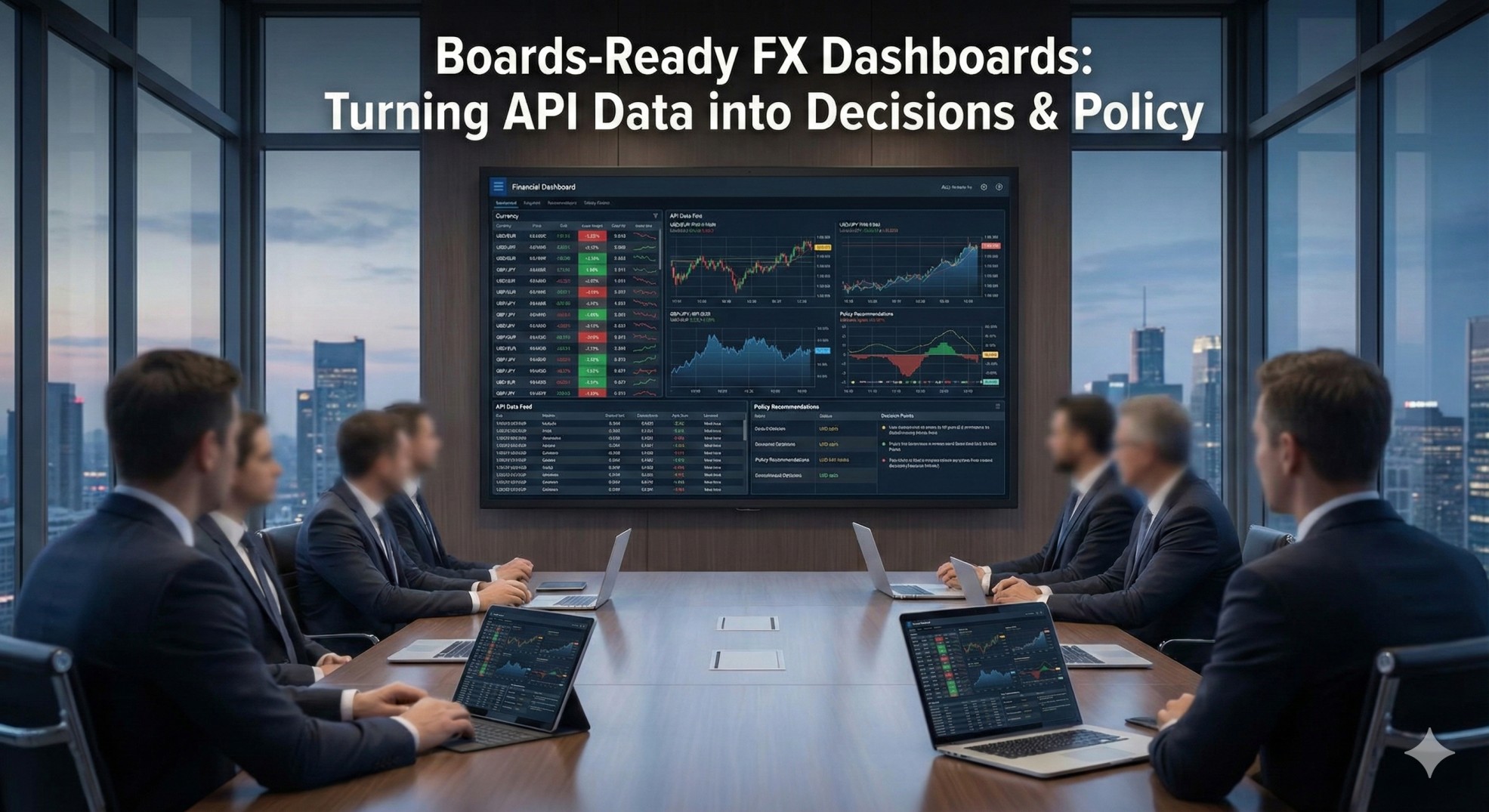
When Exchange Rates Become Boardroom
Those who have attended a board meeting during a week of currency volatility know that when the CFO says, “Our exposure just wiped 2% off margins overnight,” the room becomes silent.
In an era where international trade is always evolving, FX dashboards have evolved from treasury games to strategic tools for leadership. When it comes to hedging tactics or financial decisions, real-time data sent over a trustworthy FX API for Treasury Management could mean the difference between accepting or responding to currency risk.
Insufficient Guidance And An Abundance Of Knowledge Are The Problems In The Boardroom.
Even though companies now get ridiculous amounts of data from Bloomberg terminals, Excel sheets, ERP exports, and Slack updates, the boardroom frequently only sees a static PDF every quarter. Making a distinction between executives who receive delayed data and FX traders who view live market broadcasts is risky.
According to the Deloitte 2024 Treasury Survey, over 60% of CFOs said that “delayed or fragmented FX data visibility” was the biggest obstacle to a successful hedging plan. Boards are forced to rely on out-of-date data when making decisions about capital allocation and transfer pricing in the absence of a live FX API for Treasury Management.
Think about it: would you use the exchange rates from last week to determine your annual import budget? Obviously not.
Using the API Revolution to Transform Spreadsheets into Real-Time Strategy
You can get real-time currency rates, historical data, and volatility indicators for your dashboard or ERP by connecting straight to live market data sources via an FX API (foreign exchange application programming interface).
This plug-and-play is made possible by providers such as OANDA, XE, Currencylayer, and IBRLIVE. However, depending on how you utilize that API, a “board-ready” dashboard differs from a generic data stream.
In addition to providing the data, a good FX API for Treasury Management contextualizes it.
- It creates images such as a real-time forex chart that displays the discrepancy between the assumptions in your budget and the currency you are exposed to (for example, INR/USD).
- Heatmaps of forex risk that highlight the most volatile regions.
- trackers that show the real-time discrepancies between budgeted and actual hedged holdings.
As a result, the financial dashboard becomes a radar system instead of a rearview mirror.
Knowledge for Making Decisions: The Value of Board-Readiness
Beautiful charts are not as important as clear charts in terms of being “board-ready.”
Three questions should be swiftly answered by the CEO or a member of the audit committee after viewing a dashboard:
- How much foreign exchange risk are we now exposed to?
- Do our hedges comply with the law?
- How would our budget rates and profitability change if the USD rises by 3%?
In just a few seconds, such responses can be measured thanks to live APIs.
For instance, IBRLIVE’s FX API for Treasury Management was directly included into the ERP by the CFO of an Indian manufacturing company.Thanks to VaR-based exposure analytics, the board may now examine real-time INR/USD, INR/EUR, and USD/CNY prices rather than depending on dealers’ daily updates.In the event of intraday rupee spikes or changes to RBI policy, the CFO can suggest prompt adjustments to hedge coverage.
This method transforms data into policy.
The Benefit of IBRLIVE’s India-Centric Focus
IBRLIVE has greater experience with Indian FX corridors than other global APIs, despite the fact that major global providers like OANDA and XE offer comprehensive international coverage.
For board-level analytics, IBRLIVE stands out due to the following features:
- Localized feeds: INR-linked pairs obtained from low-latency interbank data are known as localized feeds.
- RBI-compliant integration: The RBI’s rules for fintech and AD-II businesses that have to abide by Indian law are met by this integration.
- Customizable data layers: Tableau, Power BI, and internal ERP dashboards can all receive data straight from APIs.
- Built for decisions, not speculation: IBRLIVE, in contrast to trading APIs, is designed for corporate treasury and compliance requirements rather than speculation.
The boards of Indian importers, exporters, and fintech companies not only require “fast” but also auditability, correctness, and localization.
Important Dashboard Data That Every Board Must View
A board-ready FX dashboard combines executive simplicity with financial transparency. Among the most successful are:
| Metric | Why It Matters |
| Net Open Position (NOP) | Shows if the company is over or under-hedged. |
| Budget Rate v/s Live Rate | Instantly highlights deviation from policy assumptions. |
| Market-to-Market P&L | Real-time profitability of outstanding hedges. |
| Currency Correlation Chart | Reveals how multi-currency exposures interact. |
| FX Volatility Index | Alerts boards to increased market risk. |
| Scenario Simulator | Models potential outcomes (e.g., “What if USD/INR hits 86?”) |
FX Dashboards’ Impact on Regulation
- Aligning Policies for Hedging
- Treasury heads can dynamically modify hedge coverage in response to volatility triggers by utilizing dashboards that use live FX API data.
- For example, a board review of hedging ratios may be prompted by an automated warning if the INR falls by more than 2% in a single week.
- Budgeting and Forecasting
- Assumptions change instantly when FX API data is linked to ERP budgeting components.
- Policy conflicts are minimized by ensuring that quarterly budgets employ the same base rates as the Treasury.
- Regulating one’s willingness to take risks
- Dashboards show the foreign exchange risk in line with the board-established restrictions.
- Automated processes may notify the Risk Committee or CFO if VaR surpasses tolerance.
- Compliance with Regulations and Audits
- Proven real-time visibility into foreign exchange risk is necessary for SEBI and RBI.
- Companies can record exchange rate data with timestamps for audit trails using IBRLIVE’s FX API for Treasury Management.
An Actual Case: When Policy Was Affected by Data
During the 2023 dollar boom, there were noticeable fluctuations in the foreign exchange of an Indian software company that made money in both the US and Europe. Their CFO inflated and harmed profit margins by ₹3 crore by using static rate files that were only updated once every day.
The IBRLIVE’s FX API for Treasury Management was used to transition to a real-time dashboard. Within weeks, the board had access to real-time USD/INR fluctuations, daily variance alerts, and exposure statistics.
The result? By employing a dynamic hedging strategy based on real-time data, the company was able to reduce its yearly foreign exchange losses by 40%.
FAQs
Q1. How does a “board-ready” dashboard appear?
A: It’s easy. On a single screen, complex FX data should be transformed into insights for exposure, P&L, and policy action.
Q2. Is there an FX API that is free to use?
A: For experimentation, of course. However, free APIs may not be appropriate for board reporting due to their limited currency coverage and delayed rates.
Q3. How often should decision dashboards be refreshed?
A: For corporate dashboards, every 30 to 60 seconds; for active treasuries, more frequently.
Q4. What distinguishes IBRLIVE from worldwide APIs for CFOs?
A: It ensures policy dependability by offering real-time, India-compliant INR data and rapid communication with regional treasury systems.
