
Introduction: The Missed Opportunity in Clear View
Think about this: Your CRM helps a sales team track leads, your ERP keeps the books balanced, and your SaaS platform (if you’re an ISV) takes care of specific problems. But what happens if those leads, invoices, or SaaS transactions include cross-border payments?
This means using static conversion tables, laborious spreadsheets, or worse, no integration at all, for most systems. This resulted in unhappy clients, lost chances, and squandered money.
The truth is that by incorporating an FX Widget API for CRM and ERP that is backed by a reliable forex API, CRMs, ERPs, and ISVs may turn a tedious task into a tool that generates income. Similar to ignoring real-time charts when trading forex, you will ultimately be burned if you neglect this in today’s global market.
The Revolutionary Nature of FX Widgets
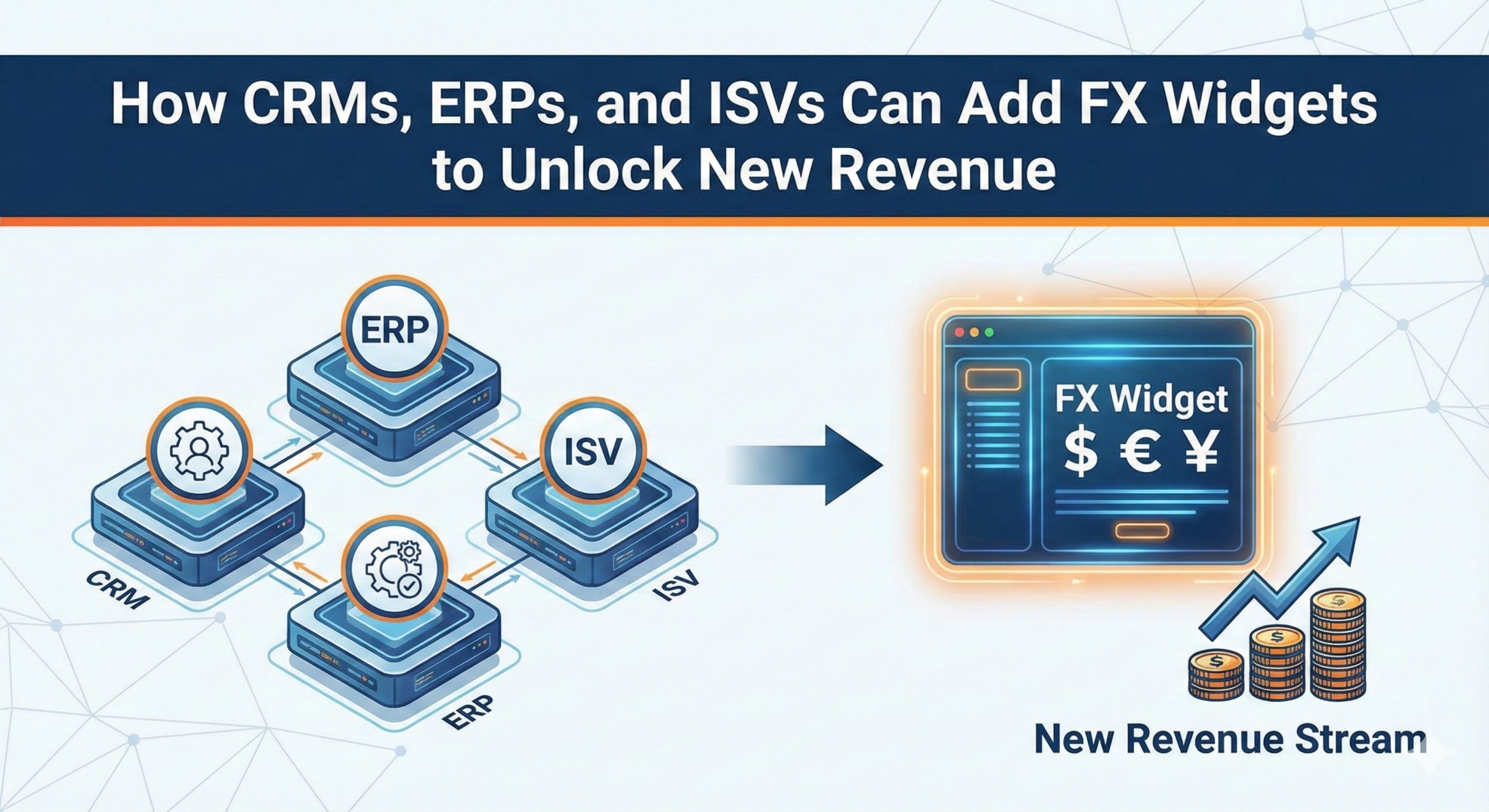
So, what is an FX widget? It is just a little widget that displays the current currency rates directly on platforms that businesses now use, like an ERP module, CRM dashboard, or SaaS product interface. An exchange rate or currency conversion API frequently supports it.
What makes it significant? because speculating is not permitted in international trade. Remittances were expected to reach over $860 billion globally in 2022, with over $100 billion going to India alone, according to World Bank projections. Every transaction was impacted by the foreign exchange rates.
In addition to making things more convenient, providing customers with a currency converter widget that displays the most recent foreign exchange rates fosters trust and promotes repeat business.
Which advantages do CRMs, ERPs, and ISVs provide?
Let’s have a look.
- CRMs
Think about adding a multi-currency widget directly to the Salesforce or Zoho dashboards. If sales teams bidding in USD could easily swap to INR or EUR, cross-border transactions would close more smoothly. By upselling content for premium tiers, FX widget integrations can be quite advantageous for CRMs.
- ERPs
ERPs now manage procurement, billing, and accounting. With the inclusion of an ERP currency tool, CFOs can now reconcile bills in real time without errors caused by stale rates. That’s not just efficiency; that’s retention.
3. ISVs (Independent Software Vendors)
Software as a service (SaaS) providers often see ISV revenue enhancement as a result of niche functionality. Adding a foreign exchange plugin to a logistics ERP or travel software as a service (SaaS) not only reduces customer aggravation but also gives competitors an unrivaled competitive edge.
Six Strategies to Earn Money in Various Currencies
- Premium Pricing Models
Give complex CRM/ERP solutions support for several currencies. If the real-time exchange rates are correct, businesses will pay more.
- Transaction Oriented Revenue
Every time a customer makes use of the global payments API, platforms may get a small fee. Think of it as SaaS-style toll collecting.
- The integrated financial cross-selling approach
You can package add-ons like FX hedging, insurance, and payment processing once you have control over the currency exchange API touchpoint.
- Reduce the Attrition of Customers
If your ERP makes managing foreign exchange easier, why would a CFO switch? Retention is the same as indirect monetization.
- Analytics Based on Services
Give customers access to financial data APIs so they may see historical exchange rates. Dashboards with advanced insights are not free.
- White Label Prospects
ISVs can license their FX widgets to partners or resellers to create new recurring revenue streams.
Real-World Examples
Salesforce AppExchange: A lot of currency apps now generate revenue by offering currency conversion APIs or dashboard widgets. Monthly users pay $5 to $50 for what should have been a fundamental function.
Microsoft Dynamics ERP: It integrates real-time currency rates via APIs to support treasury operations, illustrating how ERPs can be used in international finance beyond accounting.
Shopify: When third-party products like Bold Multi-Currency are utilized, localized pricing is shown using current currency values, which instantly boosts checkout conversion rates.
Lesson? A demand exists. Platforms only need to capitalize.
Developer Corner: Embedding Guide for FX Widget API for CRM and ERP
So, how can ERP modules or CRM dashboards incorporate foreign exchange rates?
- Choose an API provider: Currencylayer, Fixer.io, OANDA, and IBRLIVE are your options.
- Obtain an API Key: After registering and authenticating, you will receive your access token.
- Call the Endpoint: For instance, GET /latest?base=USD → yields JSON including every currency that is accessible.
- Display the widget: Make a simple real-time currency widget.
- Prepare for Downtime: Take cache values into account when planning for downtime. You run the danger of disaster if you ignore this; it’s similar to investing heavily in a forex deal without a stop-loss.
- Secure It: Always use HTTPS + API authentication to protect financial data.
From the Front Lines: Human Views
I once worked with an Indian SaaS developer who thought he could use a free exchange rate API to run his ERP solution more affordably. The problem? The feed was delayed by twenty-four hours. A consumer who handled bills totaling lakhs was charged an out-of-date rate. Refunds followed, disputes became increasingly acrimonious, and his brand’s reputation took a hit.
Switching to a real-time currency exchange API fixed the issue. The developer swiftly changed the feature’s name to “global-ready” in an effort to increase both revenue and expenses.
What does the story teach us? Free currency converter APIs could be helpful for blogs, but if your SaaS, CRM, or ERP is on the line, you need speed and accuracy.
The Factors That Make IBRLIVE the Widget Contest Winner
Let’s be honest: Global APIs like XE and OANDA are excellent for broad coverage. However, Indian CRMs, ERPs, and ISVs occasionally treat INR as an afterthought.
In this case, IBRLIVE’s FX Widget API for CRM and ERP:
- Local Accuracy: Information produced for Indian operations with an emphasis on INR.
- RBI Alignment: RBI Alignment is more compliant than generic suppliers.
- Low Latency: Sub-second updates to stop CRMs and ERPs from serving stale numbers.
- Developer-friendly: Clear REST APIs, JSON responses, and easy onboarding.
If you’re serious about making money with multi-currency support in ISV products with FX widgets, IBRLIVE gives you speed and credibility.
Conclusion: Stop Managing Data, Start Monetizing It
Adding a currency converter tool to your ERP or CRM is not only practical, but it also increases income. Future market leaders will be platforms with built-in FX and finance widgets.
Or, to paraphrase the trading floor, you are trading forex blindly and losing money (and pip) if you disregard FX widgets.
FAQs
Q1: What potential advantages might FX widget connections offer CRMs?
A: By upgrading FX widgets to premium levels, assessing transaction costs, and offering analytics dashboards.
Q2. What risks are associated with using free APIs?
A: Free APIs usually have a short uptime, are slow, and are not compliant. They work with hobby websites, but not with real-money CRMs and ERPs.
Q3: Does an ERP need a lot of code to support many currencies?
A: I concur. APIs like IBRLIVE make it possible to integrate multi-currency widgets without the need for programming knowledge by using REST/JSON requests.
Q4: What are the advantages for ISVs of using SaaS platforms that handle multiple currencies?
A: By licensing the widget, upselling premium tiers, or connecting global payments APIs for transaction-based revenue.
