Print E-BRC is a critical step for every Indian exporter who wants to claim export incentives under the Foreign Trade Policy. An E-BRC (Electronic Bank Realization Certificate) is a digital confirmation issued by banks to certify that export proceeds have been realized in foreign currency and credited to the exporter’s account.
With the digitization of export documentation, exporters can now view and print BRC online through the DGFT portal without any physical paperwork. This guide explains the complete process of print E-BRC, e BRC download, and how to use DGFT BRC for incentive claims.
What Is E-BRC and Why It Matters?
An E-BRC is issued electronically by authorized banks and uploaded directly to the DGFT BRC system. It acts as:
Proof of export realization
Mandatory document for export incentives
Verification tool for DGFT and Customs
Without an E-BRC, exporters cannot claim benefits such as:
RoDTEP
RoSCTL
Duty Drawback
Interest Subvention
GST Refund
Process to View and Print BRC Online (DGFT BRC)
The DGFT has migrated the earlier system to an upgraded digital repository, making it easier to view and print BRC in just a few steps.
Click on Login and enter your DGFT User ID & Password
Go to My Dashboard and select Repositories
Click on Bills Repository
Choose Bank Realizations / Reconciliation (E-BRC)
Enter shipping bill details or select a date range
Click Search to view and print E-BRC or proceed with e BRC download
💡 Tip: Always download the PDF version and keep it saved for audits and incentive claims.
How to Use DGFT BRC for Export Incentives
Shipping bills are electronically generated on ICEGATE (Indian Customs EDI Gateway). These bills are automatically transmitted to DGFT. To claim incentives:
The exporter must link shipping bills with the relevant DGFT BRC
DGFT compares:
Realized export value (from E-BRC)
FOB value (from shipping bill)
The incentive amount is calculated on the lower of the two values.
Important Point to Remember
✔ Ensure your bank uploads the correct realized value ✔ Partial realization must be updated by the bank ✔ Incorrect E-BRC values can delay or reject incentive claims
If required, request your bank to revise the E-BRC before you proceed to print E-BRC.
How E-BRC Is Generated by Banks
Export payment is received
Amount is credited to exporter’s bank account
Bank settles shipping bills in EDPMS
Bank uploads foreign exchange value (INR) as per CBIC rates
E-BRC appears in DGFT portal
Exporter can view and print BRC instantly
Export Incentives Where Print E-BRC Is Mandatory
RoDTEP
RoSCTL
Duty Drawback
GST Refund
Interest Equalisation Scheme
FAQs – Print E-BRC & DGFT BRC
1. How can I print E-BRC online?
You can print E-BRC by logging into the DGFT portal, accessing Bills Repository, and downloading the E-BRC PDF.
2. Is e BRC download mandatory for export incentives?
Yes, e BRC download is mandatory to claim benefits like RoDTEP, RoSCTL, and duty drawback.
3. Can I view and print BRC without bank assistance?
Yes, once uploaded by the bank, exporters can view and print BRC directly from the DGFT portal.
4. What is DGFT BRC used for?
DGFT BRC is used to verify export realization and calculate incentive eligibility.
5. What should I do if E-BRC value is incorrect?
Request your bank to revise the uploaded E-BRC before you proceed to print E-BRC or submit claims.
How to take printout of e-BRC?
To take a printout of e-BRC, log in to the DGFT portal using your registered credentials. Go to My Dashboard → Repositories → Bills Repository → Bank Realizations/Reconciliation (e-BRC). Search using your shipping bill number or date range, open the required e-BRC, and select the print or download option.
What is e-BRC in export?
An e-BRC (Electronic Bank Realization Certificate) is a digital certificate issued by authorized banks confirming that export proceeds have been received in India. It serves as official proof of foreign exchange realization and is mandatory for claiming export incentives such as RoDTEP, RoSCTL, duty drawback, GST refund, and other DGFT benefits.
How to generate e-BRC from DGFT portal?
Exporters cannot manually generate an e-BRC on the DGFT portal. Once export payment is received, the authorized bank uploads the realization details electronically after settling the shipping bill in EDPMS. The e-BRC is then automatically generated and made available for view and print BRC on the DGFT portal.
Can we get BRC online?
Yes, BRC can be obtained online through the DGFT portal in the form of an e-BRC. Exporters can log in, search their bank realization records, and download or print e-BRC without visiting the bank physically.
How do I check my BRC details?
To check BRC details, log in to the DGFT website and navigate to Bank Realizations/Reconciliation (e-BRC) under the Bills Repository. Enter the shipping bill number or relevant date range to view details such as realized amount, bank name, and realization date.
What is the cost of IEC certificate?
The cost of obtaining an IEC (Import Export Code) certificate from DGFT is ₹500. This is a one-time government fee, and the IEC remains valid for a lifetime unless surrendered or cancelled.
Convera payment is a trusted global solution for international education and B2B cross-border transfers. Earlier known as Western Union Business Solutions (WUBS), Convera has evolved into a technology-led payments company offering secure, transparent, and compliant international transactions.
Today, Convera is recognised as the world’s largest non-bank B2B cross-border payments provider, supporting over 30,000 clients including students, universities, corporates, financial institutions, legal firms, and NGOs.
This updated guide explains how Convera works for students in India, covering GlobalPay, login access, payment gateway features, and payment tracking—without overusing keywords.
What Is Convera and Why Is It Trusted Globally?
Convera is a global payments platform designed to simplify international transfers while maintaining regulatory compliance. It is widely used for overseas tuition payments because institutions receive the exact amount without hidden deductions.
With support for more than 140 currencies, the platform allows payments in the local currency of the receiving institution, reducing exchange-related issues and delays.
GlobalPay for Students is Convera’s education-focused solution. It enables students and parents to send tuition fees safely while choosing from multiple payment methods.
Key highlights:
Pay in the institution’s preferred currency
Transparent pricing
Faster settlement timelines
Online status updates
This makes convera payment a preferred option for international fee transfers from India.
Convera Login and Payment Gateway
After initiating a transfer, users receive access to the Convera login portal. Through this dashboard, users can:
View payment instructions
Access the secure payment gateway
Download confirmations and receipts
Monitor transaction progress
The gateway uses encrypted channels to ensure data security and regulatory compliance across borders.
How Convera Payment Tracking Works
One major advantage of this platform is real-time tracking. Once a transaction is initiated, students can monitor the status online and receive confirmation when funds reach the institution.
Typically, payments from India are settled within 3 to 5 working days, depending on the chosen method and bank processing timelines.
Payment Methods Available from India
Students in India can complete international transfers using:
Bank transfers via major Indian banks
Payments through authorised Convera Agent locations
Electronic transfers initiated online
These options ensure flexibility while adhering to RBI and LRS regulations.
Can You Pay at a Convera Agent Location?
Yes. Students who prefer offline assistance can initiate a transaction online and complete it at an authorised agent location in India.
The process involves:
Selecting the institution
Entering student details
Choosing “Agent Location” as the payment method
Completing payment using provided instructions
Payment status can then be checked online through the tracking feature.
TCS Rules on Education Payments
As per India’s Liberalised Remittance Scheme (LRS):
A 5% TCS applies if total overseas remittance exceeds ₹7,00,000 in a financial year (without an education loan)
A 0.5% TCS applies when payments are made through an approved education loan
Is TCS Refundable?
Yes. The tax collected at source can be adjusted while filing Income Tax Returns (ITR). The amount is reflected in Form 26AS linked to the PAN of the remitter.
Benefits of Using This Platform for Tuition Transfers
Using convera payment for education offers several advantages:
Institutions receive the full amount
No surprise bank deductions
Multiple payment options
Online tracking facility
Reliable global compliance
These features reduce stress for students and parents making overseas payments.
A Convera payment is an international transfer processed through Convera’s secure platform, commonly used for tuition fees and global business payments. Most education payments are routed via Convera GlobalPay, ensuring the institution receives the full amount without bank deductions.
What is the payment method for Convera?
Convera supports multiple payment methods, including bank transfers from Indian banks, online electronic transfers, and payments through authorised agent locations. All payments are processed via the Convera payment gateway, which ensures compliance and secure settlement.
Does Convera charge a fee?
Convera usually does not apply hidden charges to students. Any applicable costs or exchange rates are displayed clearly before confirming the transaction through Convera GlobalPay, helping users avoid unexpected deductions.
What is Convera used for?
Convera is used for international education payments, tuition fee transfers, and B2B cross-border transactions. Universities and institutions worldwide rely on Convera’s payment gateway for accurate, timely, and compliant global payments.
How do I send money to Convera?
To send money, initiate a transfer through Convera GlobalPay by selecting your institution and entering payment details. After generating instructions, you can complete the transaction online or at an authorised agent location and access details via Convera login.
Is Convera safe to use?
Yes, Convera is considered a safe and reliable platform. It uses encrypted systems, follows international compliance standards, and provides Convera payment tracking, allowing users to monitor the payment until it is successfully received by the institution.
PayMyTuition is an advanced international payment platform by the MTFX Group of Companies, a global provider of secure and technologically advanced payment solutions. For over 25 years, the company has partnered with education institutions, multinational organisations, banks, law firms, and travel agencies to simplify cross-border payments. Learn more about MTFX
Students can use this platform to pay tuition and other academic expenses in their local currency, helping them save significantly on transfer and currency exchange fees. Cost savings for each payment can reach thousands of dollars.
The service offers competitive pricing and lower transfer costs compared to banks and other providers. In addition, multilingual customer support is available through phone, email, 24/7 live chat, and Skype, making the payment process seamless and efficient.
In this guide, we will cover:
How to create an account
Steps to pay university fees online
Where to download the payment receipt
Accepted payment methods
What to do if a country is not listed
What to do if an institution is not available
How to get assistance with payment instructions and transfers
How to create a PayMyTuition account
Step 1: Visit the official website Step 2: Enter your personal details and set a strong password Step 3: Accept the terms and conditions Step 4: Click Create Account to complete the process
Steps to pay university fees
Visit the official website
Select your educational institution from the dropdown list
Choose the country you are sending funds from and enter the payment amount
Pick your preferred payment method in local currency, such as domestic/international bank transfer, credit card, bill payment, e-transfer, or e-wallet
Log in or sign up if you are a first-time user
After creating an account:
Detailed instructions for sending money will appear
Download instructions to complete the transfer online or at a bank branch
Track the payment in real time via your dashboard
Depending on your payment option, you can complete, extend, or cancel the transaction
You’ll receive email or SMS notifications throughout the process
Where to find the payment receipt
Receipts are available in the PayMyTuitionPayments Center section of your dashboard for both pending and completed transactions. These receipts serve as proof of payment for your institution.
Accepted payment methods
The platform supports multiple methods:
Credit and debit cards
Bank transfers
E-wallets
Other online options
Note: Options may vary based on your location.
Card payments are displayed during the request process, and bank transfers must follow the provided instructions to ensure proper processing.
What if a country is not listed?
Some countries may be unavailable due to government regulations or sanctions. Contact your educational institution to explore alternative payment options if needed.
What if an institution is not listed?
Some universities require payments through their own portals. If your institution does not appear in the selection list but the platform is mentioned on their website, contact them for the correct link and instructions.
Getting assistance with PayMyTuition payment instructions and transfers
IBRLIVE INDIA PVT LTD, based in Panipat, Haryana, helps students generate payment instructions and complete international education payments at competitive exchange rates.
1. Is PayMyTuition safe? Yes, PayMyTuition is a secure platform for international tuition payments. It uses advanced encryption technology and trusted banking channels to ensure your funds and personal information are fully protected.
2. Who is PayMyTuition? PayMyTuition is an international payment service provided by the MTFX Group of Companies. It helps students and educational institutions process cross-border tuition payments efficiently and cost-effectively.
3. Is PayMyTuition available in my country? PayMyTuition is available in many countries worldwide. However, some countries may not appear in the payment dropdown due to government regulations or sanctions. You should check with your educational institution for alternatives if your country is not listed.
4. How long does it take to get your refund from PayMyTuition? Refund processing times depend on your payment method. Typically, bank transfers or card payments may take 3–10 business days to reflect in your account. PayMyTuition notifies you via email or SMS once the refund is processed.
5. How secure is my financial information with PayMyTuition? Your financial details are highly secure with PayMyTuition. The platform follows strict compliance with global financial regulations and uses encryption, secure payment gateways, and monitoring systems to protect sensitive information at every stage.
GIC full form – The name “GIC” stands for “Guaranteed Investment Certificate,” and it refers to a short-term liquid investment that Canadian banks typically issue for up to a year. It is intended for Indian students who wish to enrol at universities that are part of the Student Partners Program (SPP) in Canada.
In this section, we are going to discuss how is GIC account beneficial for students as well as the key factors any Student who wishes to aspire abroad education must know about the term.
As we have discussed the deposit investment known as a guaranteed investment certificate (GIC) is offered by banks and trust organizations in Canada. Because of the low-risk fixed rate of return they offer and the fact that they are partially guaranteed by the Canadian government, people frequently buy them for retirement planning.
Benefits from a GIC account:
Low concern: Term deposits and GICs are typically regarded as low-risk investments that are secure since the principle is always guaranteed.
Assurance of growth: Your GIC investment will generate interest regardless of what happens in the markets.
Flexibility: There are a variety of term and interest rate choices. Either pick a cashable GIC that allows you to retrieve your money before the term expires or lock your money in to earn a greater interest rate.
Simple to maintain: As relatively inexpensive and predictable and require little monitoring, they are simple to comprehend and maintain.
Savings Defense: If someone is truly interested in saving money for studying abroad, a savings protection GIC is a better alternative than a savings account.
Frequently Asked Questions:
How to open a student GIC account from India?
When opening a GIC account from India, it is important to ensure that the chosen financial institution participates in the program that meets the requirements for international students. Additionally, individuals should be prepared to provide the necessary documentation, such as a passport, study permit, and proof of funds, to complete the account opening process.
You can create a GIC account online through ICICI bank by following the steps mentioned below:
Visit the ICICI Bank Canada website and select the “Student GIC Program” option and click on New User Registration.
Complete the online application form with all necessary personal and financial information.
Upload scanned copies of your passport, study permit, and any other required documentation.
Download the funding instruction page and share it with your bank to make the wire transfer. Please note that the payment can be sent through banks and other AD II companies.
Once the funds have been received, ICICI Bank will issue a GIC certificate and email it to you.
You can then use the GIC certificate to apply for your Canadian study permit.
GIC: Is it superior to a savings account?
In this instance, a GIC is a terrific solution for investing novices. Your money is secure since it is guaranteed, and the interest rates are frequently higher than those provided by high-interest savings accounts.
What is the GIC’s minimum & maximum amount?
The amount you can put into a GIC has no upper limit. The majority of GICs offer fixed interest rates for predetermined terms, such as half-yearly, a year, two years, or up to ten years. The minimum Guaranteed Investment Certificate (GIC) amount for Indian students applying for a Canadian study permit is currently CAD 10,000.
When the minimum amount of GIC is CAD 10000, then why do we need to send CAD 10175 or CAD 10200?
The reason for sending CAD 10,200 or CAD 10175 instead of the minimum required amount of CAD 10,000 for the Guaranteed Investment Certificate (GIC) program is to cover the transaction fees and other bank charges associated with the transfer of funds to Canada. After the deduction of transfer fees, the bank deposits the balance amount in your GIC account.
Best way to open a GIC account & making payments at the lowest exchange rate?
Students can open a GIC account through ICICI bank’s student GIC programs detailed above and it hardly takes 5 minutes to open a GIC account online. For making the payment you need to compare exchange rates and transaction charges offered by various institutions. The best way is to visit ibrlive.com and contact them for making your payment at the best possible lowest exchange rate and transaction fees. They help you in opening the GIC account and sending your payment at affordable rates by saving you time and money.
GIC: Does it pay interest every month?
For GICs with durations of one year or more, interest is computed daily on the principal amount and is paid either monthly, yearly, or at maturity after compounding annually. For GICs with durations less than a year, interest is accrued daily and paid at maturity based on the principal.
Can my GIC account be broken before maturity?
The Guaranteed Investment Certificate (GIC) account for Indian students in Canada is open for a period of one year. The GIC account is a requirement of the Canadian government’s Student Direct Stream (SDS) program, which is available to international students from India, China, the Philippines, and Vietnam who are applying to study at a Designated Learning Institution (DLI) in Canada.
The funds in the GIC account are held for the duration of the student’s first year of study in Canada and are intended to help cover the student’s living expenses while studying in Canada.
After the first year, the funds from the GIC account can be withdrawn in instalments to help cover living expenses or other expenses related to their studies in Canada. It is important to note that the GIC account must remain open for the full one-year period as a requirement of the SDS program, and the funds cannot be accessed until the end of the one year.
What is the GIC full form?
The GIC full form is Guaranteed Investment Certificate. It is a secure financial product mainly used in Canada, offering fixed returns over a specific period.
What is a GIC account?
A GIC account is an investment account where money is deposited for a fixed tenure at a guaranteed interest rate. It is commonly used by international students in Canada as proof of funds.
How to open a GIC account?
To open a GIC account, you need to apply through a Canadian bank, submit identity documents, transfer the required funds, and receive a confirmation certificate after approval.
What are the benefits of GIC?
The benefits of GIC include guaranteed returns, low risk, predictable income, and acceptance by Canadian immigration authorities as proof of financial stability.
What is GIC Canada and why is it important?
GIC Canada refers to the investment required by international students to cover living expenses while studying in Canada. It ensures financial security during the stay.
What is GIC CIBC?
GIC CIBC is a Guaranteed Investment Certificate offered by the Canadian Imperial Bank of Commerce. It is widely accepted and popular among students applying for Canadian visas.
Is a GIC account mandatory for Canada student visa?
A GIC account is mandatory for students applying under the Student Direct Stream (SDS) to Canada, as it proves sufficient funds for living expenses.
Can GIC funds be withdrawn early?
Most GIC accounts have lock-in periods, and early withdrawal is either restricted or comes with penalties, depending on the bank’s terms.
Please feel free to contact us if your question is not answered here and you still have concerns. We promise to assist you as best we can.
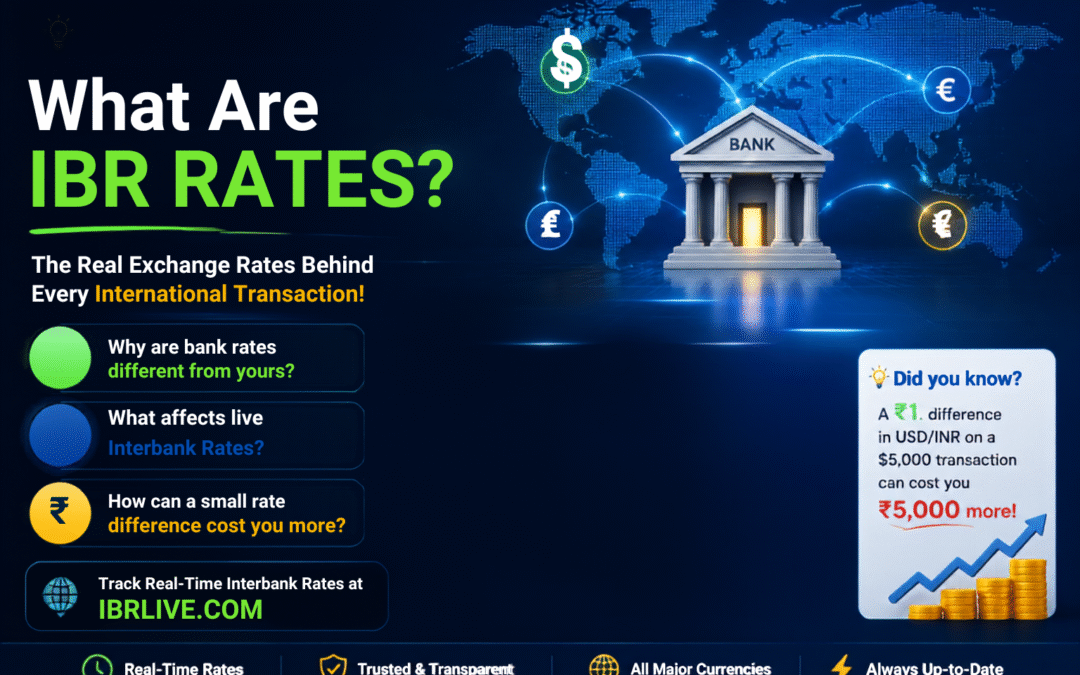
What Are IBR Rates? Meaning, Live Interbank Exchange Rate & Why They Matter
IBR Rates, also known as Interbank Exchange Rates, are the real-time foreign exchange rates at which banks trade currencies with each other in the global forex market. These rates are considered the benchmark exchange rates for international currency transactions and are widely used by banks, financial institutions, importers, exporters, and forex platforms worldwide.
For example, the IBR rate for USD refers to the live exchange rate at which banks exchange the United States Dollar against the Indian Rupee or other currencies in the interbank market.
Businesses and individuals closely monitor Interbank Rates because they directly impact:
International money transfers
Import-export payments
Forex card pricing
Foreign currency exchange
Overseas education payments
Travel expenses
What are IBR Rates (Interbank Exchange Rates)?
The interbank exchange rate is the exchange rate at which banks buy and sell currencies among themselves. These rates are usually available only to banks and large financial institutions because they involve high-volume forex transactions.
IBR Rates are also known as:
Spot Rates
Interbank Forex Rates
Wholesale Forex Rates
Live Market Exchange Rates
The interbank market is the world’s largest financial market, where global banks continuously trade currencies like:
United States Dollar
Euro
British Pound Sterling
Japanese Yen
Australian Dollar
Canadian Dollar
These rates change every second depending on global market demand and supply.
How Do Interbank Rates Work?
The interbank market is one of the world’s largest financial markets, where global banks continuously trade currencies like United States Dollar, Euro, and British Pound Sterling. According to the Bank for International Settlements, the global forex market trades trillions of dollars daily.
When banks need foreign currencies for international settlements, they buy and sell currencies from each other through the interbank forex market.
For example:
One bank may need USD for import payments.
Another bank may have excess USD liquidity.
The exchange takes place at the prevailing Interbank Exchange Rate.
These transactions happen electronically in real time across global forex trading networks.
The rates are quoted with:
Bid Price → the rate at which banks buy currency
Ask Price → the rate at which banks sell currency
The small difference between these prices is called the spread.
How Are Interbank Rates Determined?
IBR Rates are determined primarily by supply and demand in the global foreign exchange market.
Several factors influence Interbank Exchange Rates:
1. Economic Data
Economic indicators such as:
inflation
GDP growth
employment data
trade balance
can significantly impact currency demand.
2. Central Bank Policies
Interest rate decisions by central banks strongly affect currency movements.
For example:
RBI policies affect INR movement.
US Federal Reserve policies impact the interbank dollar rate globally.
3. Political Events
Elections, geopolitical tensions, trade wars, and government policies can create volatility in forex markets.
4. Global Market Sentiment
Investor confidence and global risk appetite also influence currency demand.
Why Do Interbank Rates Change Every Second?
Unlike fixed exchange rates, Interbank Exchange Rates are dynamic.
Currencies are traded 24 hours a day across:
London
New York
Singapore
Tokyo
Hong Kong
As millions of forex transactions happen globally, Rates continuously fluctuate based on:
market liquidity
global demand
economic news
institutional trading activity
Live Example:
Suppose the live interbank dollar rate is:
USD/INR = ₹96.8302
A retail customer may receive:
₹97.80 to ₹99.50 for forex card loading or currency exchange after bank markup.
This difference occurs because banks and forex providers add:
operational charges
risk buffers
profit margins
For example, if a student or traveler exchanges $5,000:
At the live Interbank Exchange Rate of ₹96.8302, the total cost would be approximately ₹4,84,151.
At a retail forex rate of ₹98.00, the total cost becomes ₹4,90,000.
That’s a difference of nearly ₹5,849 due to markup over the live interbank rates.
This is why businesses, importers, exporters, students, and travelers closely monitor the interbank dollar rate and real-time exchange rate for usd before making international payments.
Difference Between Interbank Exchange Rates and Forex Card Rates
Feature
IBR Rates
Forex Card Rates
Used By
Banks & Institutions
Retail Customers
Margin
Very Low
High
Market Type
Wholesale Forex Market
Retail Forex Market
Real-Time
Yes
Often Marked Up
Spread
Minimal
Wider
Best For
Large Forex Transactions
Travel Spending
While these Rates reflect the actual market value of a currency, Forex Card Rates include additional bank margins.
For example, banks like ICICI Bank display their own retail forex card pricing, which is usually higher than the live Interbank Exchange Rate.
Many people ask why customers cannot access the same rates banks receive.
The reason is that banks add margins to cover:
currency fluctuation risks
operational costs
payment processing
liquidity management
profit margins
Retail customers usually receive marked-up exchange rates compared to the wholesale interbank market.
Why Are Interbank Rates Important?
1. International Money Transfers
When businesses or individuals send money internationally, exchange rates directly impact the final amount received.
Better exchange rates can save substantial costs on:
tuition fee payments
import payments
overseas transfers
business remittances
2. Importers and Exporters
Import-export businesses monitor the Rates daily because even small forex fluctuations can significantly impact profit margins.
For example:
Importers prefer a stronger INR.
Exporters benefit from a weaker INR.
3. Forex Market Benchmarking
The Interbank Exchange Rate acts as the benchmark rate for:
banks
forex companies
remittance providers
travel card providers
4. Economic Impact
Currency strength affects:
exports
imports
inflation
foreign investments
trade competitiveness
A stronger domestic currency can make exports more expensive globally.
Difference Between Google Exchange Rate and Interbank Rates
Google exchange rates are generally mid-market reference rates collected from financial data providers.
However, actual Interbank Exchange Rates can differ slightly because:
forex markets move continuously
banks trade at different bid-ask spreads
liquidity conditions vary
The live interbank dollar rate changes every second during active forex trading hours.
Where Can You Find Authentic & Real-Time Rates?
Many websites display currency exchange rates, but not all provide authentic real-time Interbank Exchange Rates.
A reliable source should provide:
live forex market updates
real-time interbank pricing
multi-currency support
transparent exchange rates
generally look for real-time wholesale forex market pricing.
Common Use Cases
IBR Rates are widely used for:
International wire transfers
Import-export settlements
Forex trading
Currency risk management
Overseas education payments
Travel planning
Treasury operations
Global business payments
FAQs About IBR Rates
What is an Interbank Exchange Rate?
An Interbank Exchange Rate is the rate at which banks exchange currencies with each other in the wholesale forex market.
Is IBR Rate the Same as Spot Rate?
Yes, IBR Rates are commonly referred to as spot exchange rates because they represent real-time market pricing for immediate currency settlement.
What is the interbank dollar rate?
The interbank dollar rate refers to the live wholesale exchange rate for the United States Dollar in the interbank forex market.
Why are Forex Card Rates higher than IBR Rates?
Forex card providers and banks add margins over Interbank Exchange Rates to cover operational costs and currency risks.
Can individuals get Interbank Rates?
Retail customers usually do not receive exact Interbank Exchange Rates because banks apply markups and spreads on retail forex transactions.
Why do Interbank Rates fluctuate constantly?
IBR Rates change continuously due to:
global forex trading activity
economic news
central bank decisions
market demand and supply
Conclusion
Interbank Rates play a critical role in the global foreign exchange ecosystem. These live Interbank Exchange Rates serve as the benchmark for international currency trading and influence everything from import-export transactions to travel forex cards and international remittances.
Understanding how IBR Rates work can help businesses and individuals make smarter forex decisions, reduce currency conversion costs, and better understand global market movements.
Whether you are tracking the interbank dollar rate, searching for the latest ibr rate for usd, or comparing forex card pricing, knowing the difference between retail exchange rates and live Interbank Exchange Rates is essential in today’s global economy.
A forex card rate is like a display board where a bank publishes exchange rates for buying and selling foreign currencies, travel cards, and currency notes. The spread between buying and selling currencies in a card rate is generally kept very wide. For example, SBI forex card rates for USD/INR can be in the form of the below-mentioned table:
Currency
Bank Buying Rate
Bank Selling Rate
TT Buying rate
Bills Buying rate
Currency notes
Travel card
Traveller’s cheques
TT Selling rate
Bills Selling rate
Currency notes
Travel card
Traveller’s cheques
Demand draft
United States Dollar (USD)
80.94
80.94
79.45
80.69
80.69
84.58
84.58
85.94
84.36
84.36
84.24
When a bank displays a card rates for foreign exchange, it may show both the TT buy rate and the TT sell rate. The TT buy rate is the rate at which the bank will buy foreign currency from the customer in exchange for local currency. The TT sell rate is the rate at which the bank will sell foreign currency to the customer in exchange for local currency. The difference between the TT buy and TT sell rates is known as the bid-ask spread, and it represents the bank’s profit margin for facilitating the transaction. The bid-ask spread can vary depending on various factors, such as market conditions, currency volatility, and the size of the transaction. Customers need to understand the Bank’s card rate and the bid-ask spread to make informed decisions about foreign exchange transactions and to minimize the costs associated with such transactions.
Do the Forex Card Rate of each bank differ?
The Fx Card Rates can differ across banks. Each bank sets its own exchange rates based on a variety of factors, such as its cost of acquiring foreign currency, operating expenses, and profit margin. For Example HDFC Bank Forex Rates for USD/INR may differ with ICICI Bank Forex Rates and SBI Forex Card Rates Today.
The differences in Foreign Exchange Card Rates across banks can impact the cost of foreign exchange transactions for customers. Therefore, comparing the fx card rates offered by different banks before making a foreign exchange transaction is essential to get the best possible rate.
What is the difference between the Forex Card Rate & Interbank Exchange Rate?
The Forex card Rate vs Interbank Exchange Rate are two different rates used in foreign exchange transactions. The main differences between the two are:
Definition: The Interbank Exchange Rate is the rate at which banks buy and sell currencies with each other in the wholesale market. It is used by banks to settle their transactions and by other financial institutions as a benchmark for pricing their foreign exchange products.
On the other hand, the foreign exchange card rate, refers to the rate derived on a daily basis by bank based on the Interbank Exchange Rate by keeping a substantial margin on buy and sell foreign exchange transactions. Generally the margin loaded in card rate is more than 1 rupee on USD/INR transactions, 2 rupee on EUR/INR transactions and 3 Rupee on GBP/INR transactions. This margin can vary across banks based on their different strategies and other market factors.
Calculation: Numerous economic considerations and market dynamics of supply and demand as well as market dynamics of supply and demand, influence the Interbank Exchange Rate. While the bank’s profit margin, the interbank rate, and any other fees or charges are all included in the Bank’s Card Rate, which is established by the bank.
Spread: The difference between a currency pair’s purchasing and selling rates for a currency pair is known as the bid-ask spread. Due to banks’ high volume of transactions, the spread for Interbank Exchange Rate is normally quite small, with only a few pips. For example the spread between USD to INR IBR rate for hdfc bank forex exchange rates today may be 1 to 3 paisa only. As a result of the bank’s profit margins and other expenses related to supplying retail consumers with foreign exchange services, the gap in Fx card rate is often greater and can range between 1 to 3 Rupees.
Source: Card Rates can be found on specific bank’s website for Example ICIC Bank Forex Card Rates can be found on link available on ICICI Bank’s official website. Whereas Interbank Rates ca be found on the most trusted forex website ibrlive.com.